The latest word on re-burns and carbon storage

A group of prominent researchers just analyzed data from a large number of burned field sites in Alaska, collected from 2021-2023.  The Bonanza Creek Long-Term Ecological Research program at UAF has been funded by the National Science Foundation since 1987 and they have established an impressive network of fire effects plots across interior Alaska.  For this analysis on the fate of stored carbon they examined 555 recently (within 7 years) burned plots contained in 31 separate fires across diverse boreal forests, with pre-burn stand ages ranging from 11-254 years.  Including the most recent burn, 26 of the sites burned 3 times according to fire records and ecological data.

The analysis indicated that increasing fire frequency and reburning will significantly reduce C storage capacity through progressive consumption of more biomass (mainly duff) with subsequent fire events, as well as shift forested toward non-forested landscapes.  Part of the C loss results from the second fire consuming the fallen burned trees from the previous fire.  Under the unique conditions that prevail in the boreal landscape, these logs are typically overgrown and buried by moss in a couple decades. There, the cold, acidic environment slows decay so that this wood can be preserved for centuries, but when fire returns to the site quickly the woody debris is consumed before it can be buried in the “bank”.

In short, a recovery period of < 70 years between fire events is not sufficient to reaccumulate C stores in the forest floor between fires and makes it likely that legacy C will be lost with each subsequent fire. 

Read the article: Walker, XJ, et al.  2025. Increasing wildfire frequency decreases carbon storage and leads to regeneration failure in Alaskan boreal forests. Fire Ecology 21:57.

Alaska–is it still a Carbon sink?

New data compiled in NOAA’s 2024 Arctic Report card illuminates the delicate balance between boreal/arctic regions production of carbon dioxide (especially fire smoke and microbial respiration) and it’s uptake (by photosynthesizing vegetation). This balance is sensitive to ambient temperature, and of course is influenced in various ways by wildfire. Slowing down the atmospheric increase in CO2 from burning fossil fuels has taken on some urgency as we see more and more adverse impacts from warmer atmosphere and oceans due to its greenhouse effects. Land management and fire management may have a role to play, especially as we race to develop alternative energy sources. Take a look at this well-illustrated 8-p summary to bring yourself up to speed with what’s happening with carbon in the north country. Link to the report: https://doi.org/10.25923/0gpp-mn10

“When including wildfire emissions, the Arctic tundra region has shifted to a carbon dioxide (CO2) source and is a consistent methane (CH4) source.” (Natali et al. 2024, NOAA Technical Report OAR ARC ; 24-11)

Photo by R. Reanier: Anaktuvuk R Fire, July 14, 2007

Fire Management to Reduce Carbon Emissions?

By Randi Jandt, Brendan Rogers, and Carly Phillips

This research brief is available as a standalone PDF

To thwart runaway climate warming, the global community is struggling to find strategies to limit carbon dioxide (CO2) emissions that are steeply climbing.  Increasing boreal wildfires in Alaska and Canada also threaten to increase CO2 emissions and could contribute potentially 12 gigatons to the world’s carbon headache by mid-century.

Fire Management strategy could make a difference: A research team from The Woodwell Climate Research Center and Union of Concerned Scientists wondered whether fire management offered a realistic way to slow down the release of legacy carbon in boreal forests, giving Nature and humans time to adapt and implement other mitigation strategies.  How much would it cost to keep Alaskan wildfires at their historic level, avoiding climate-induced predicted increases? And was it even possible to make a difference? In short, the study found that—yes—more fire suppression could keep nearly 1/3 (4 Gt ) of that carbon in the ground in Alaska and Canada. The study tries to estimate costs associated with carbon savings and compares them to other carbon-sparing strategies being used or planned. Project goals are below are from a presentation given to Alaskan fire managers last fall.

Download our short Research Brief above (and/or you can access the full scientific article, open access, HERE:

Phillips, et al. 2022.

Escalating carbon emissions from North American boreal forest wildfires and the climate mitigation potential of fire management.

Science Advances, Vol. 8(17), https://www.science.org/doi/10.1126/sciadv.abl7161

C.A.R.V.E. and the Carbon Detectives

How do you know whether forest fires or factories and diesel generators are responsible for Black Carbon or CO2 in the air or deposited in icefields?  An experiment called CARVE (Carbon in Arctic Reservoirs Vulnerability Experiment) led by Chip Miller of the NASA Jet Propulsion Laboratory was conducted in Alaska’s airspace and some results just published explain how the source can be identified.  The combustion of woody biomass (or more importantly in Alaska–layers of compacted dead moss and organic soil) liberates primarily carbon deposited since World War II into CO2.  That modern post-bomb carbon contains traces of radioactive  carbon (Δ14C) in contrast to fossil fuels, deposited in prehistoric times, which have none.

carve

CARVE:  Sherpa aircraft flew sensors over fires in Alaska in 2013 to measure atmospheric concentrations of gases.


During the CARVE experiment, Sherpa aircraft flew sensors to measure atmospheric concentrations of CH4, CO2, and CO and parameters that control gas emissions (i.e. soil moisture, freeze/thaw state, surface temperature). They directly flew over some fires (including fires near Fairbanks and Delta) to measure the “fingerprint” concentrations of isotopes released by typical boreal burning.  Mouteva et al. (2015) published findings that showed most of the C in the summer skies over Alaska in 2013 was indeed attributable to forest fires and the age of the biomass converted to black carbon averaged about 20 years (range 11-47 yrs).  The authors also explore using the carbon isotope “fingerprint” of fires to estimate the average depth of consumption–since Δ14C increases with depth from the surface moss to the mesic horizon.  Pooled results of radioactive isotope fractions yielded an average depth of burn of about 8 inches for the 2013 Alaska fires–a result that may vary depending on fuel conditions.  Burn severity, expressed as depth of consumption, is a hot topic among agencies and land managers because it drives ecological response to burning as well as vegetation changes which may come with the hypothesized climate-driven increased boreal burning.

Citation:  Mouteva, G. O., et al. (2015), Black carbon aerosol dynamics and isotopic composition in Alaska linked with boreal fire emissions and depth of burn in organic soils, Global Biogeochem. Cycles: 29, doi:10.1002/2015GB005247.


Fire and Carbon Stores: the Rest of the Story

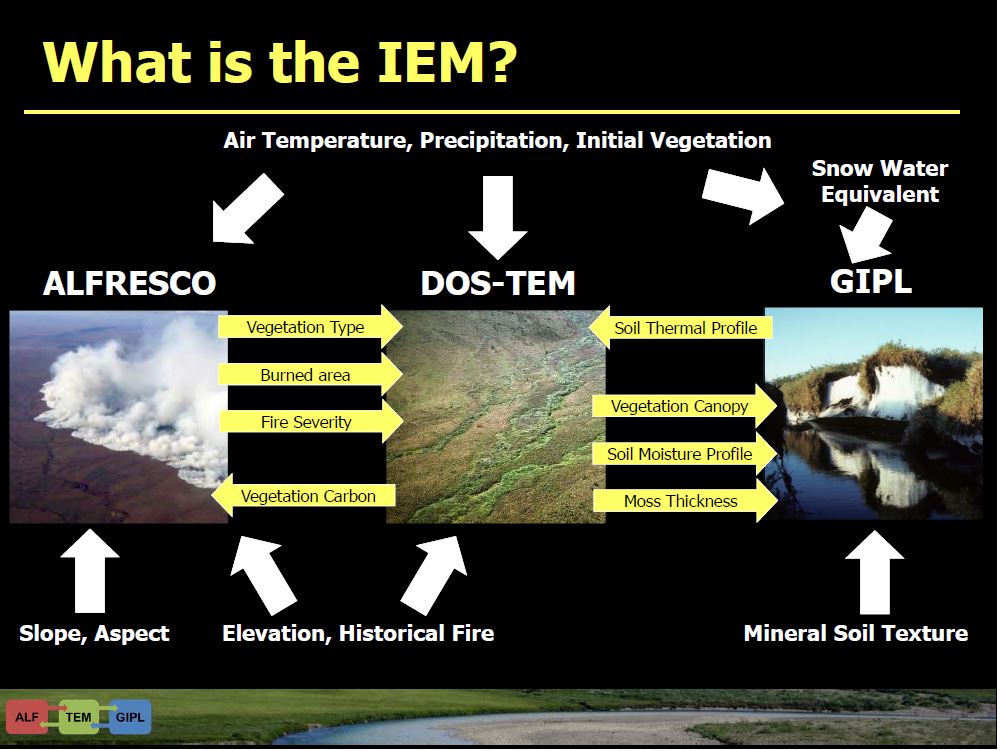
Estimates of carbon released from combustion of vegetation and organic soil during wildfires have improved dramatically over the past decade.  Biomass inventory, fire effects and fire severity studies have contributed more accurate data to improve these models. (See Ottmar 2007, Brendan Rogers webinar 2015)  However, figuring out the net effect of all the various effects of fire, the recovery phase and warming climate on the carbon stored in Alaska’s forests and tundra is a lot more challenging!  You’d have to consider changes in burn extent and/or severity, increases in plant productivity in recovering burns, changes in species composition and what that means for productivity, changes in permafCaptureIEMrost distribution and soil C decomposition, methane emissions and carbon fluxes in lake systems and wetlands–etc.!  A team lead by Dr. Dave McGuire at UAF has taken on this modeling challenge by applying their Integrated Ecosystem Model (IEM) which includes modules for fire, permafrost, and carbon cycling. Dave recently presented an overview of their findings at an IARPC-WCT/AFSC joint webinar (available HERE).  In a nutshell, they found: 1) tundra holds 2x the carbon that boreal forest does in the same area 2) there has been a net C loss from boreal land area of about 8 Tg/yr over the last 60 years, primarily driven by large fires during the 2000’s 3) arctic tundra and SE Alaska still act as C sinks, compensating for these losses so that overall, Alaska sequesters about 3.7 Tg/yr,  4) increases in fire extent predicted with with warming climate will release even more C, but longer growing seasons and increased plant growth (as much as 8-19% increased productivity throughoCaptureALFut the remainder of this century) with warmer climate and higher CO2 concentration in the atmosphere are estimated to offset these losses under most of the climate projection scenarios. Since this nutshell summary glosses over a lot, you should take a look at the presentation and the SNAP projects page with information on scenarios and the individual models used.