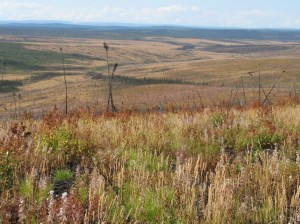
Climate, Fire, Frost and the Carbon Bank: This 2-page research brief summarizes several years of field studies–citing recently published articles–by USGS soil scientists Jennifer Harden and Kristen Manies. Their studies shed new light on the impact of fires on permafrost in Alaska boreal forest, and interactions of fire effects and freezing effects on the forest floor. The insulating moss/duff layer plays a critical role in protecting permafrost and conditions suitable for the rapid regrowth of permafrost are keys to determining whether boreal forest will retain its ability to store large amounts of biomass carbon. Read More >> | Download PDF (1.5 Mb)
Category New Publications
State of the (Alaska) Climate–What’s Really Happening to Temperature, Rainfall, Sea Ice and Fire?
The latest findings on predicted vs. observed climate trends across the US were presented at a Webinar hosted by ACCAP and the National Climate Assessment Team–Alaska Chapter on March 6, 2013. Presenters were Dr. John Walsh, a well-known weather and climate scientist from UAF, and Dr. Sarah Trainor, Director of ACCAP. The Alaska Fire Science Consortium recently posted a summary on the findings that are especially relevant to Alaska and to the fire management and science communities. You can download a copy HERE. Also, the Webinar was recorded and is still available for viewing at ACCAP’s website: https://accap.uaf.edu/?q=webinar/national-climate-assessment-alaska-chapter
Smoke Science Plan: The Path Forward
The Joint Fire Science Program just published the September 2012 Issue of Fire Science Digest:
“Smoke Science Plan: The Path Forward”
Read it here. (Click the “Full Screen” button for the best viewing.)
Can’t access the document above?
Download the full pdf here: http://www.firescience.gov/Digest/FSdigest14.pdf
More Catastrophic Fires Ahead for Western U.S.
News from Science Daily:
More Catastrophic Fires Ahead for Western U.S..
Read the Full Journal Article:
J. R. Marlon, P. J. Bartlein, D. G. Gavin, C. J. Long, R. S. Anderson, C. E. Briles, K. J. Brown, D. Colombaroli, D. J. Hallett, M. J. Power, E. A. Scharf, M. K. Walsh. PNAS Plus: Long-term perspective on wildfires in the western USA. Proceedings of the National Academy of Sciences, 2012; DOI: 10.1073/pnas.1112839109
Direct from the Source:
Once burned, twice shy: Repeat fires result in black spruce regeneration failure (Webinar)

A re-burned fire with little to no black spruce regeneration, 2007. Photo courtesy of C. Brown.
Dr. Carissa Brown, Postdoctoral Researcher at the University of Sherbrooke, will be joining us for a webinar on February 23, 2012 (11:00 am to noon AKST) entitled “Once burned, twice shy: Repeat fires result in black spruce regeneration failure.” Dr. Brown is currently studying plant species and communities at the edge of their range, focusing on the direct and indirect effects of climate change on species distribution at northern latitudes. Most recently, her work has focused on the responses to altered fire frequency at the northern margin of the boreal forest, particularly in black spruce forests.
Link to recording <HERE>
2012 Brings a New Look for the Joint Fire Science Program
JFSP Resprouting as FireScience.gov!
The Joint Fire Science Program (JFSP) launched into 2012 with a completely new web look and feel. Their new site is packed with new features and channels to help you stay connected.
- For daily information, be sure to follow Firescience.gov, the Regional Consortia (including Alaska!), and others in the increasingly robust wildland fire community on Twitter. It’s painless to sign up and you don’t have to actualy “Tweet” if you don’t want to!
- If you’re on Facebook be sure to Like their Facebook page to receive updates and information of interest to the wildland fire community.
- Most importantly – Join the JSFP Mailing List for newsletters and announcements. Check out the latest January 2012 release or browse previous newsletters. If you like what you see, use the links at the bottom to forward to anyone you think would benefit from broad, timely, relevant fire science updates.
On Fire: The Official Blog of Firescience.gov
The new blog – On Fire – brings you facts, insight, and commentary on the latest wildland fire science findings, management tools and recommndations. In the coming weeks they will be adding slideshows, videos and guest bloggers. Subscribe and share!
Hot Off the Press – AFSC December Newsletter
The Alaska Fire Science Consortium December 2011 Newsletter is now available!
In This Issue:
- Fire in Alaska Video
- 2011 Fire Science Workshop
- Fire Science Highlights Blog
- New Publications: Our Top Picks
- Upcoming Webinars
Read the full Newsletter HERE.
Fuel reduction projects could increase carbon emissions

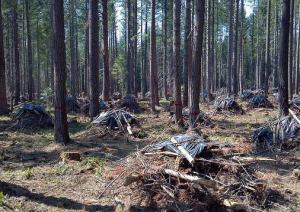
Forest thinning, such as this work done in the Umpqua National Forest in Oregon, may be of value for some purposes but will also increase carbon emissions to atmosphere, researchers say. (Photo courtesy of Oregon State University)
News from Science Daily:
Forest health versus global warming: Fuel reduction likely to increase carbon emissions.
Read the full Journal Article:
John L Campbell, Mark E Harmon, Stephen R Mitchell. Can fuel-reduction treatments really increase forest carbon storage in the western US by reducing future fire emissions? Frontiers in Ecology and the Environment, 2011; : 111215051503003 DOI: 10.1890/110057
Direct from the Source:
Rapid rise in wildfires in large parts of Canada? Ecologists find threshold values for natural wildfires

"A rapid rise in wildfires has been predicted for a large part of Canada" (Credit:Evgeny Dubinchuk/Fotolia) (Photo from Science Daily)
News from Science Daily:
Read the Journal Article behind this summary:
1. Richard D. Zinck, Mercedes Pascual, Volker Grimm. Understanding Shifts in Wildfire Regimes as Emergent Threshold Phenomena. The American Naturalist, 2011; 178 (6): E149 DOI: 10.1086/662675
Local Alaskan Scientist Featured in New York Times: “As Permafrost Thaws, Scientists Study the Risks”
Local scientist Katey M. Walter Anthony (Aquatic Ecosystem Ecologist at UAF) has been studying the amount of methane gas being released into the atmosphere from thawing permafrost. As long frozen plants and other organic materials begin to thaw, they also begin to decay, producing methane gas. Katey has been collecting gas samples from frozen “bubbling” lakes near Fairbanks, Alaska to see just what we’re up against.