
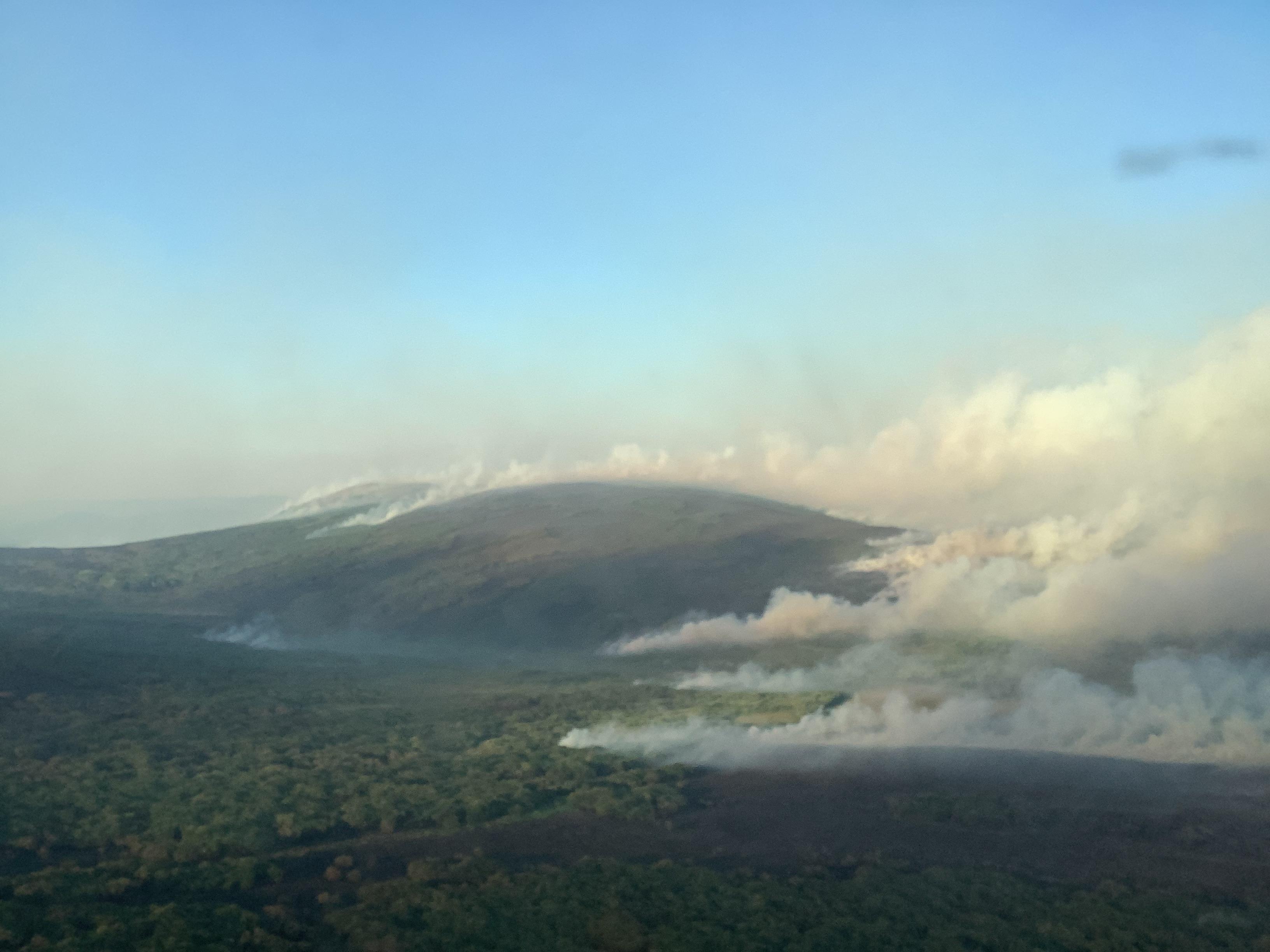
A recent paper by Lucas Diaz, et al. (2026) builds upon previous work to more accurately estimate the carbon impact of southwest Alaska tundra fires. When Moubarak, et al. 2023 studied the after-effects of the 2015 tundra fires, they found that 910,000 metric tons of carbon were released in emissions alone from the 134,000 acres of fires in that region. More recently, Diaz’ team studied the 2022 Apoon Pass/East Fork fires in southwest Alaska using similar methods to tie field measurements to satellite-generated burn severity metrics. Just these two fires in 2022 released the carbon equivalent of 6,876,178 barrels of oil, not counting any post-fire release due to permafrost thaw, nor the carbon footprint of the fire suppression efforts. Tussock tundra emitted an average of 1.59 ± 0.55 kg C m−2 during combustion. In 2022 burn depth averaged 7 cm, so only 11% of the total pre-fire carbon stock was consumed–mostly duff organic soil. These estimates compare favorably with Moubarak’s earlier findings of 1.68 kg C m−2 for the 2015 tundra fires. Moubarak further calculated that those fires would have a warming impact on the atmosphere for about 80 years, given the long residence time of CO2 in the atmosphere. Links to these Open Access articles are below:
Citations:
Diaz, L. R., Saperstein, L.B., van Gerrevink, M.J., Wangchuk, S., Hessilt, T.D., Janssen, T.A.J., Scholten, R.C., Delcourt, C.J.F. and Veraverbeke, S. 2026. Fire severity and carbon combustion from tussock tundra fires in Southwest Alaska. Environ. Res.: Climate 5 025011.
Moubarak, M., Sistla, S., Potter, S., Natali, S. M., and Rogers, B. M. 2023. Carbon emissions and radiative forcings from tundra wildfires in the Yukon–Kuskokwim River Delta, Alaska. Biogeosciences, 20, 1537–1557.
 AK Fire Science Highlights