Download the latest Roundup with brief highlights of new publications that may interest the Alaska fire science and management community HERE. The fall Roundup includes links to articles on improvements in ranking fire risk around communities and structures, new findings on changes in fire regime in Alaska and Canada, implications of increases in high latitude fire on the atmosphere, and interesting findings on toxic components in fire retardant chemicals. Here’s the URL to a downloadable version:
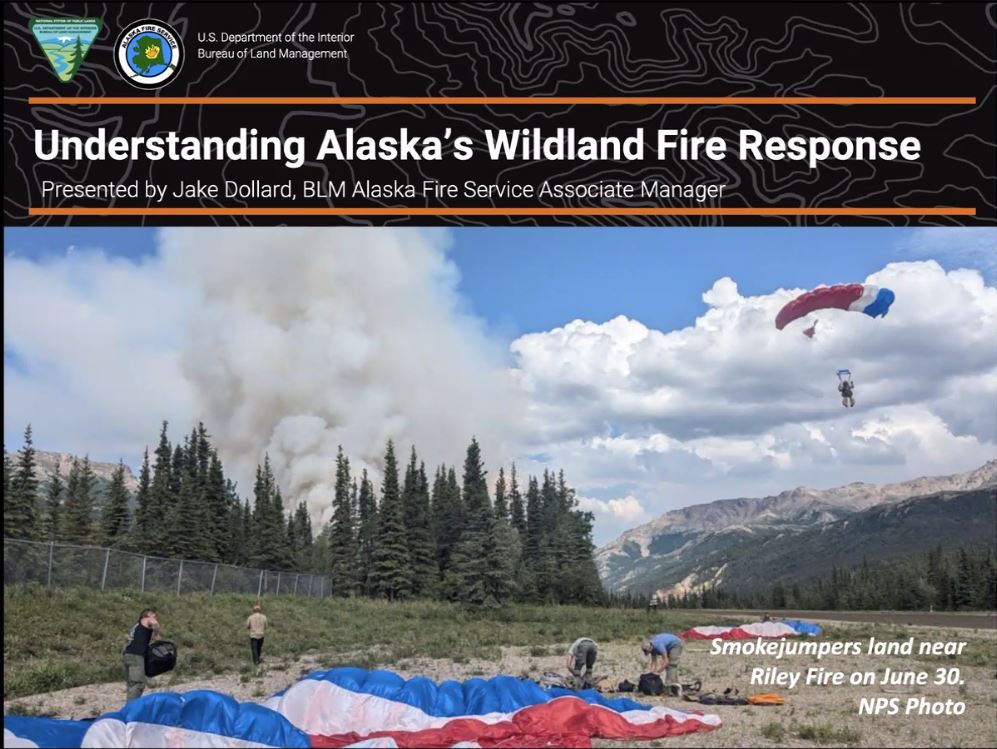
Also, if you missed this webinar, be sure to check out the recorded presentation “Spark to Strategy“–by Rick Thoman (ACCAP) and Jake Dollard (Alaska Fire Service) on the 2024 fire season and how fire management plans turn into actions in Alaska.
Caribou lichens, Cladonia (Cladina) spp., are a slow-growing, vital winter forage for caribou. They are commonly called “reindeer moss” but aren’t really moss. And they are important to both reindeer and to caribou. Eric Palm (2022), for his PhD thesis, used GPS-collared caribou locations from several agencies in Alaska to show that caribou strongly avoided burned areas, especially in winter, and that their preference was related to lichen abundance. He concluded that: “caribou will experience increasing winter habitat loss as fire frequency and severity increase [in a warmer climate]. . . .We suggest that management strategies prioritizing protection of core winter range . . . would provide important climate-change refugia for caribou.” In a separate study, Matt Macander et al. (2020) demonstrated effective satellite mapping of lichen-rich ranges in Alaska, and his analyses also reinforced the caribou preference for habitat areas with >30% lichen cover.
Often you hear that lichens are only important in winter, but Libby Ehler (2021) used GPS video collars as well as diet analysis from droppings to show that lichens dominated caribou summer diet for the Alaska Fortymile Herd: 59% of composition of fecal pellets and 39% of observed foraging on the video collars in summer was lichen (vs. 37% shrubs). Only in June and July did the videos record a little more browsing on shrub than lichen, and in winter caribou expend a lot of energy locating and digging for rich patches of ground-hugging lichens. Previous studies demonstrated similar diet dominance by lichens in other herds in Alaska and Canada.
Now, in a new study, Liming He, of Natural Resources Canada, has documented large-scale decline in these lichen habitats in Eastern Canada. His study derived caribou lichen cover maps for two time periods ~30 years apart (1980’s, & 2020’s) using Landsat satellite imagery for a large area including several boreal caribou population ranges. Lichen cover declined in 62% of the region evaluated and increased in 11%. Fires were responsible for a quarter of the decrease, even in a region of Canada where fires have been relatively rare. The larger part (3/4) remains unexplained, with warming-induced shrub encroachment high on the list of suspects. Although we do not yet have a comparable study for Alaska, Macander et al. (2022) found lichen had declined 13% as a plant functional type in Alaska from 1985-2020, in a study that also used Landsat satellite data.
Taken together, these studies should alert wildlife and land managers about a possible habitat crisis on the horizon for Alaska’s 2nd largest subsistence resource. Indeed, most caribou herds across North America are experiencing declines, including the Western Arctic Caribou herd—once Alaska’s largest—featured in a recent Alaska Beacon article. The George River Caribou Herd in eastern Canada was the world’s largest in the 1990’s (800,000 animals) but by 2022 was down to just 7,200. Part of that herd’s decline is thought to be based on habitat degradation from overuse.
As one significant boreal research project (the NASA Arctic Boreal Variability Experiment) winds down, another important research collaboration is winding up, thanks to hard work by a group of scientists in Bonanza Creek Long-Term Ecological Research unit (BNZ-LTER). Both projects have tackled important fire science and management issues in Alaska. Although BNZ-LTER grew from the Bonanza Creek Experimental Forest (beginning in the 1980’s) and Caribou-Poker Creek Watershed, it’s work now expands across Alaska and western Canada and includes collaborating researchers from many locations, but especially University of Alaska and Northern Arizona University. BNZ-LTER also welcomes broad collaboration from land and resource managers and community stakeholders.
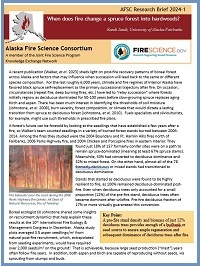
Research at the BNZ-LTER has always had a strong wildfire component.Dr Michelle Mack leads the unit as their Principal Investigator, as well as heading Northern Arizona University’s (NAU) Plant and Ecosystem Ecology Research Lab. In May 2023, Dr. Mack and her team were awarded a renewed grant of $7.6 m from the National Science Foundation for support through 2029. The project, titled Changing Disturbances, Ecological Legacies, and the Future of the Alaskan Boreal Forest, has several subtopics, including a Wildfire Working Group led by Dr. Xanthe Walker (NAU). The wildfire group is studying direct and indirect effects of fire, such as seedling re-establishment, effect on soil microbes, overwintered fires and stream chemistry. They are also studying fire management activities like fuel breaks. One recent publication by Walker, Mack, Johnstone, and others is highlighted in our latestResearch Brief: When does fire change a spruce forest into hardwoods?The paper discusses what has been learned from the LTER’s extensive network of post-fire forest plots on drivers and thresholds of stand-type conversions—a hot topic for a number of management applications.
Can’t help but notice with this year’s fires in interior Alaska, some burned readily into recent (<20 year old) burn scars, like the Delta fire, Hillbilly and Ponds fires southeast of Fairbanks (figure). Fires to the southwest (Clear Ck and Rock Ck) are re-burning 1950’s and 1960’s burn scars but more recent burn perimeters seem to be working as fuel breaks. Fire management agencies in Alaska have traditionally relied on burn scars to act as fuel breaks, stopping or significantly moderating fire spread, for up to 50 years post-fire (Cronan and Jandt, 2008). In the 21st century, however, the phenomenon of early fire re-entry into old burns is becoming more common (Barnes 2017, Buma 2022).
While a student at UAF, Rafael Rodriguez (forestry technician with the State of Alaska in Fairbanks) showed a strong correlation between the number of times an area had burned between 1940-2010 with mean July temperature (Rodriguez 2014). In 2023, late July and August brought ideal weather for late season wildfires to the interior. Burning still exerts a strong negative feedback on re-burning within 10 years of a fire, and overall only about 4% of burned area in Alaska has burned more than once in the last 30 years (Buma, et al. 2023). Still the phenomenon of early fire re-entry, driven both by warming climate/drying fuels and by forest conversion to grassland or scrub, is very impactful for fire management decisions and agencies are carefully monitoring the trend.
Alaska Midnight Sun crew boards a bus to head for a Canadian fire assignment June 4, 2023 (Photo credit: Beth Ipsen, BLM Alaska Fire Service)
Why is the Alaska fire season so quiet this year while Canada has major wildfires? Alaska climatologist Rick Thoman attributes the lack of fires in Alaska (only 934 acres burned by the end of June) to a lack of lightning as well as cooler, moister weather this year (Alaska June 2023 Sea Ice and Wildfire). Interesting that this year Alaska retained a lot more sea ice in the Chukchi sea and Arctic Ocean above Barrow: there is some evidence linking regional climate to sea ice concentration (Zou, et al. 2021). Meanwhile, Canada is breaking records with 22.7 million acres burned (9.2 million ha) as of July 9. CiFC (https://ciffc.ca/) reports 3,678 fires spread across the entire country. Canadian and US cities (including Detroit, Pittsburgh, and Chicago) have been suffering poor air quality for much of the mid-summer with little relief in site. Is there an explanation for the unusual pattern? The global temperature anomaly for May (figure) may be one clue. Strong linkages have been found between warm temperatures and wildfire activity, mainly because of accelerated drying of vegetation fuels. In the western US, Abatzoglou and Williams (2016) found that human-caused climate change caused over half of the documented increases in fuel aridity since the 1970s and doubled the cumulative forest fire area since 1984. At any rate, 2023 brought very little snow to eastern Canada, so it melted early and Fire Weather Indices have been unusually high.
Figure from Scott Duncan (ScottDuncanWX@twitter.com)
Fire regime is changing in other parts of the world. Rebecca Scholten is finishing up a PhD in Amsterdam studying weather patterns which correlate with fire activity around the north, especially arctic areas. She’s noted that changes in the polar jet stream driven by warming global temperature seem to be correlated with more wildfire in northern tundra ecosystems. A simplified explanation would be that a “wobbly” polar jet stream caused by weaker cold sink over the Arctic can mean calming in mid-latitudes but intense heat domes, dry and windy conditions, and more convection over high northern latitudes. There seems to be a strong link with these conditions and the Siberian megafires in 2019-2021. Her recent paper in Science points to accelerating changes in high latitudes with earlier snowmelt and a tripling in the frequency of this “Arctic front jet pattern.” Curiously, when this pattern sets up, it may moderate conditions–at least with respect to winds–over interior Alaska!
Citations:
Zou, et al 2021. Increasing large wildfires over the western United States linked to diminishing sea ice in the Arctic. Nat Commun 12, 6048. https://doi.org/10.1038/s41467-021-26232-9
Abatzoglou and Williams. 2016. Impact of anthropogenic climate change on wildfire across western US forests. PNAS 113 (42) 11770-11775. https://doi.org/10.1073/pnas.1607171113
Scholten, R.C. et al. 2022. Early snowmelt and polar jet dynamics co-influence recent extreme Siberian fire seasons. Science 378, 1005–1009. https://doi.org/10.1126/science.abn4419
Smokes from East Fork Fire rise from tundra along the Yukon River around St. Mary’s, 6-12-2022. Credit: Jacob Welsh, AK IMT
Five years ago, Adam Young used paleofire evidence to hypothesize how climate warming would affect future tundra fires in Alaska. Adam basically predicted a big increase in tundra fire occurrence if the average July temperature warmed above a threshold of 13.4°C (56°F: Young, et al. 2017). This year, Arif Masrur et al. (2022) provided important evidence corroborating Adam’s theory using modern fire and climate records. The research team use machine learning to determine the relative importance of various climate, prior burn history, and biophysical values on tundra fire occurrence and size. They also tapped the rich collection of field plot data collected by the National Park Service and other management agencies for vegetation characteristics and verification of reburn status. Arif did, indeed, find a strong increase in recent Alaskan tundra fires concurrent with much warmer summers. Annual tundra burned area has almost doubled and reburned area has increased by 61% since 2010! The study also revealed a small but significant feedback effect of previous tundra fires on reburning, validating management strategies like using prescribed fire to reduce wildfire threat near villages.
Figure from Adam Young (2017) showing where he predicted shorter Fire Rotation Periods (more frequent fire) in Alaska with climate warming.
Young, AM, Higuera PE, Duffy PA and Hu FS. 2017. Climatic thresholds shape northern high-latitude fire regimes and imply vulnerability to future climate change Ecography 40:606–17. Slides and recording from Adam’s 2019 presentation on this study HERE: https://www.frames.gov/catalog/60348
Figure 2, Masrur, et al. 2022. [Tundra fire] Regime shift detected in mean annual fire frequency based on AICC fire perimeter data. The detections were performed with the target significance level p = 0.05 and cut-off length l = 20.
A paper just published by the indefatigable Adam Young, a PhD candidate at the University of Idaho, and colleagues pulls together a lot of information about climate, forest, tundra and fire to offer a glimpse of potential future fire regimes in different parts of Alaska. By looking at fire occurrence at a multi-decadal time scale, the researchers drill down into how fire rotations are likely to respond to climate projections at a regional scale.
Exerpt from Fig. 6, Young et al. 2016. Figures in the paper not only show the observed fire rotation for 19 subregions of Alaska (Figure A2 in supplement) with 60 years of fire occurrence data, but also project future rotations under various climate scenarios (in this case a mean of of 5 global climate models).
The use of advanced statistical models to build fire-landscape response models for boreal forest and tundra reaffirms prior findings of the sensitivity of fire regime to summer temperatures and moisture deficit. However, the effect is not uniform among regions: they identify a threshold at about 56⁰ F (30-yr mean temperature of the warmest month) and another threshold for annual precipitation where fire occurrence really seems to jump. This latter finding accounts for results which project large increases in 30-year probability of burning for areas where these thresholds will be crossed in the next several decades. For example, models project the Brooks Range foothills of the North Slope, Noatak tundra and the Y-K Delta may see increases in fire 4-20x greater than historical levels. Some tundra areas are likely to experience fire frequency increase to levels not observed in the paleo record, spanning the past 6,000-35,000 years. Across most of the boreal forest, fire rotation periods are projected to be less than 100 years by end of the 21st century. This is useful information for natural resources management as well as fire protection agencies—a concise, well-researched, well-illustrated paper—put it on your summer reading list.
Young, A. M., Higuera, P. E., Duffy, P. A. and Hu, F. S. (2016), Climatic thresholds shape northern high-latitude fire regimes and imply vulnerability to future climate change. Ecography 39: 1-12. http://dx.doi.org/10.1111/ecog.02205
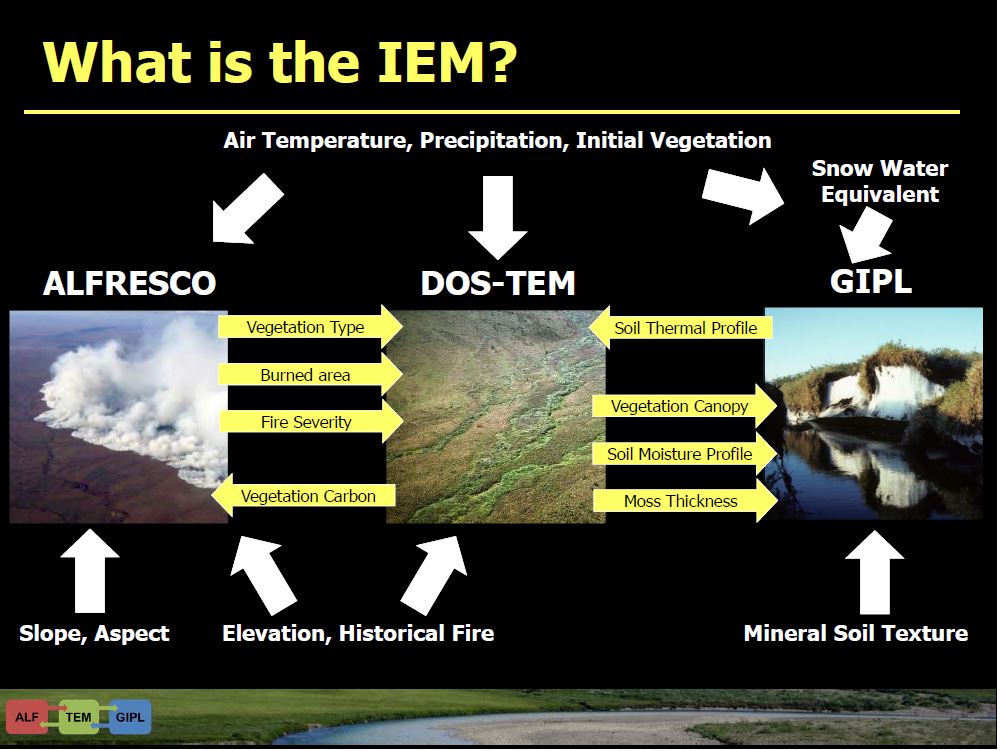
Estimates of carbon released from combustion of vegetation and organic soil during wildfires have improved dramatically over the past decade. Biomass inventory, fire effects and fire severity studies have contributed more accurate data to improve these models. (See Ottmar 2007, Brendan Rogers webinar 2015) However, figuring out the net effect of all the various effects of fire, the recovery phase and warming climate on the carbon stored in Alaska’s forests and tundra is a lot more challenging! You’d have to consider changes in burn extent and/or severity, increases in plant productivity in recovering burns, changes in species composition and what that means for productivity, changes in permafrost distribution and soil C decomposition, methane emissions and carbon fluxes in lake systems and wetlands–etc.! A team lead by Dr. Dave McGuire at UAF has taken on this modeling challenge by applying their Integrated Ecosystem Model (IEM) which includes modules for fire, permafrost, and carbon cycling. Dave recently presented an overview of their findings at an IARPC-WCT/AFSC joint webinar (available HERE). In a nutshell, they found: 1) tundra holds 2x the carbon that boreal forest does in the same area 2) there has been a net C loss from boreal land area of about 8 Tg/yr over the last 60 years, primarily driven by large fires during the 2000’s 3) arctic tundra and SE Alaska still act as C sinks, compensating for these losses so that overall, Alaska sequesters about 3.7 Tg/yr, 4) increases in fire extent predicted with with warming climate will release even more C, but longer growing seasons and increased plant growth (as much as 8-19% increased productivity throughout the remainder of this century) with warmer climate and higher CO2 concentration in the atmosphere are estimated to offset these losses under most of the climate projection scenarios. Since this nutshell summary glosses over a lot, you should take a look at the presentation and the SNAP projects page with information on scenarios and the individual models used.
The 2007 Uluksian Fire (photo courtesy of P. Higuera).
Dr. Philip Higuera (assistant professor at the College of Natural Resources, University of Idaho) will be joining us for a webinar on May 24, 2012 (1:00-2:00 pm AKDT) entitled “Tundra burning in Alaska: Rare event of harbinger of climate change?”. Philip’s current research is focused on how climate, vegetation, and human activities interact with fire occurrence and fire regimes (from across years to across millenia). He is also the Director of the Paleoecology and Fire Ecology Lab where students and researchers work on charcoal and pollen analysis in lake-sediment records, dendrochronology, and spatially-explicit modeling and analyses for areas in the US Rocky Mountains, Alaska, and abroad in Tasmania, Australia.
Dr. Philip Higuera will be presenting results from past and ongoing research focused on understanding the causes and consequences of tundra burning in the past, present, and future. The talk will integrate several lines of work, including reconstructing tundra fire history in the recent and distant past (2000-14,000 yr), quantifying relationships among modern climate, vegetation, and tundra burning, and anticipating future tundra burning given future climate scenarios.






 rost distribution and soil C decomposition, methane emissions and carbon fluxes in lake systems and wetlands–etc.! A team lead by
  ut the remainder of this century) with warmer climate and higher CO2 concentration in the atmosphere are estimated to offset these losses under most of the climate projection scenarios. Since this nutshell summary glosses over a lot, you should take a look at the presentation and the


 AK Fire Science Highlights