Hot Off the Press – AFSC December Newsletter

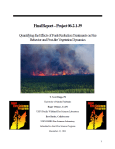
Dec 2011 Newsletter preview. Click the image to read the full newsletter.

The Alaska Fire Science Consortium December 2011 Newsletter is now available!

In This Issue:

  • Fire in Alaska Video
  • 2011 Fire Science Workshop
  • Fire Science Highlights Blog
  • New Publications: Our Top Picks
  • Upcoming Webinars

Read the full Newsletter HERE.

Nenana Ridge Experimental Burn Project – JFSP Final Report

The Nenana Ridge Experimental Burn Project (06-2-1-396) Final Report is now available from the Joint Fire Science Program.

In summary…

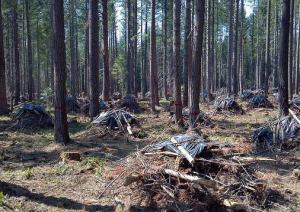
This project was funded by the Joint Fire Science Program with contributions from local, state and federal agencies. This project was designed to quantify the effects of fuels reduction treatments on fire behavior and post-fire vegetation dynamics in Alaska black spruce. The study began in 2006 with installation of four 1-acre treatment blocks. Two blocks were thinned to 8 x 8 foot spacing and limbed, one was shearbladed, and one was shearbladed and windrowed. These four blocks were replicated in the adjacent forest unit, with the intent to burn each Unit (A and B) separately. Unit A was successfully ignited on June 17, 2009.  READ MORE

Continue reading

Fuel reduction projects could increase carbon emissions

Photo from Oregon State University

Forest thinning, such as this work done in the Umpqua National Forest in Oregon, may be of value for some purposes but will also increase carbon emissions to atmosphere, researchers say. (Photo courtesy of Oregon State University)

News from Science Daily:

Forest health versus global warming: Fuel reduction likely to increase carbon emissions.

Read the full Journal Article:

John L Campbell, Mark E Harmon, Stephen R Mitchell. Can fuel-reduction treatments really increase forest carbon storage in the western US by reducing future fire emissions? Frontiers in Ecology and the Environment, 2011; : 111215051503003 DOI: 10.1890/110057

Direct from the Source:

Oregon State University News

Rapid rise in wildfires in large parts of Canada? Ecologists find threshold values for natural wildfires

Photo from Science Daily, Credit Evgney Dubinchuk/Fotolia

"A rapid rise in wildfires has been predicted for a large part of Canada" (Credit:Evgeny Dubinchuk/Fotolia) (Photo from Science Daily)

News from Science Daily:

Rapid rise in wildfires in large parts of Canada? Ecologists find threshold values for natural wildfires.

Read the Journal Article behind this summary:

1. Richard D. Zinck, Mercedes Pascual, Volker Grimm. Understanding Shifts in Wildfire Regimes as Emergent Threshold Phenomena. The American Naturalist, 2011; 178 (6): E149 DOI: 10.1086/662675

Local Alaskan Scientist Featured in New York Times: “As Permafrost Thaws, Scientists Study the Risks”

Methane Hot Spots, South Central Alaska, January 2010 (Photo by Marie-Laure Geai)

Local scientist Katey M. Walter Anthony (Aquatic Ecosystem Ecologist at UAF) has been studying the amount of methane gas being released into the atmosphere from thawing permafrost. As long frozen plants and other organic materials begin to thaw, they also begin to decay, producing methane gas. Katey has been collecting gas samples from frozen “bubbling” lakes near Fairbanks, Alaska to see just what we’re up against.

Continue reading

November 2011 Fire Science Publications

Can’t seem to stay up to date?  Let us do some of the work. 

We’ve put together a bibliography of November’s (plus or minus a few weeks) new fire science publications related to Alaska and the boreal forest.  Download a simple bibliography or an annotated version, both in a pdf format including URLs for each reference.  Just want the highlights? We showcased a few of our “Top Picks” below. 

November 2011 Fire Publications – Bibliography (pdf)

November 2011 Fire Publications – Annotated Bibliography (pdf)

Our “Top Picks”

Werth, Paul A.; Potter, Brian E.; Clements, Craig B.; Finney, Mark A.; Goodrick, Scott L.; Alexander, Martin E.; Cruz, Miguel G.; Forthofer, Jason A.; McAllister, Sara S. 2011. Synthesis of knowledge of extreme fire behavior: volume I for fire managers. Gen. Tech. Rep. PNW-GTR-854. Portland, OR: U.S. Department of Agriculture, Forest Service, Pacific Northwest Research Station. 144 p.


Continue reading