Western Forester Article on Fuel Breaks in Alaska

The first 2016 issue of Western Forester contains a pair of short articles on the Nenana Ridge crown fire experiment and fuel break effectiveness at Funny River and the studies in progress on fuel break effectiveness in Alaska.  Eric Miller (BLM-Alaska Fire Service) and Nathan Lowjewski (Chugachmiut Forester) did a nice job on these write-ups!  Eric’s article gives the first published account of what happened in 2016 when wildfire challenged a 10-year old thinned fuel break in black spruce, as well as insight to the “hows” and “whys” of fire behavior in fuel breaks.  Here’s a link to the issue:  http://www.forestry.org/media/docs/westernforester/2016/WFJanFeb2016-2_LT3qttf.pdf

DSCF0696

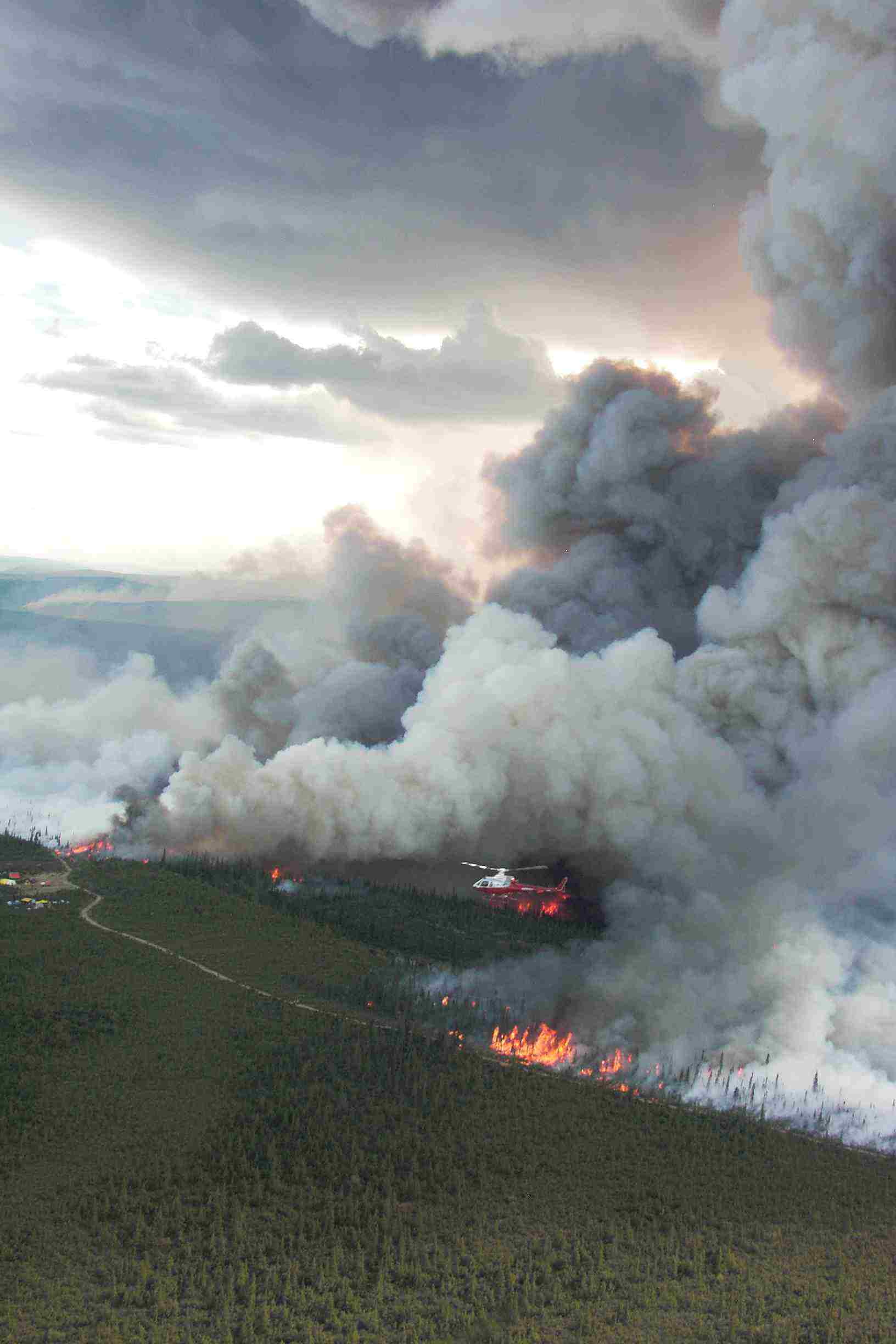
The Yukon Hot Shot Crew puts finishing touches on experimentally thinned fuel treatment blocks in June, 2007 (R.Jandt).

Ides of March–tidings of an early start to 2015 fire season

Capture-rickLate last year, Rick Thoman, NWS Climate Scientist in Fairbanks, predicted a warm winter for most of Alaska at his December 2014 NWS Webinar.  That forecast worked out pretty well, with Dec-Jan-Feb temperatures well above normal for that period all over the state! So what does he say now about the upcoming spring and start of Alaska fire season? At a March 19 forecast briefing for fire managers, Rick pointed out benefits of the newer “dynamic” climate models which continuously update their algorithms with the latest weather observations.  This kind of modeling requires major computing power so it’s only become

View Rick’s recorded monthly climate webinars posted on ACCAP’s website: https://accap.uaf.edu/?q=NWS_Briefings

possible in the last decade or so with availability of supercomputing centers.  The collection of multi-model ensembles he showed universally point to a warm or VERY WARM April (goodbye snow pack!) and that seems to extend out to the April-May-June outlook as well, with pretty good confidence.  One moderating influence in the forecast comes from mid-range precipitation outlooks from two independent forecast tools which call for above-normal precipitation, especially in the eastern Interior.  The missing link that fire managers would like to be able to forecast is convection (lightning), but Rick says that may be coming as climate modelers gain experience with the new dynamic models.  AICC Predictive Services has now posted their seasonal outlook for the 2015 Fire Season on the web, where you can learn about Modoki El Niño and what that may mean for fire season!Capture-cpc


Where fire management and carbon studies connect . . .

Screen capture of the WFEIS calculator (http://wfeis.mtri.org)

On the surface Alaska fire management and boreal ecosystem carbon studies have little in common.  But a deeper look reveals the connections between them.  Carbon scientists in the last decade have become increasingly interested in fire effects on the legacy carbon locked up in permafrost and the deep, slow-to-decompose organic layer of boreal forest floor (Kasischke et al. 2013, Genet et al. 2013).  Projections indicating more extensive, frequent and/or severe fires in northern latitudes with a rapidly warming climate, longer fire seasons, and more lightning (Romps, et al. 2014) lend a certain urgency to attempts to quantify the potential impacts of fire-released carbon on greenhouse warming.  Fire management agencies are less interested in long-term impacts of fire-released gasses but they are more and more driven to assess impacts of smoke on communities.  Work at the boundary between the two sets of interests has started to yield some interesting results.  For example, Michigan Tech Research Institute has joined their consumption field data from NASA studies to the USFS Consume Model and FCCS fuels maps and LANDFIRE fire perimeters in a web-based tool that provides users a simple interface for computing wildland fire emissions (1-km spatial resolution). The Wildland Fire Emissions Information System (WFEIS) can calculate tons of CO2 or other gases from large fires across the US and Canada from 1984-2010.  Although this tool is  for post-facto emissions analysis it is a good example of how large spatial data sets and complex equations can be united in a simple graphical interface allowing one to–say–query the forest fire emissions from the 231,000 acres burned in Alaska in 2010 (10.9 million tons CO2, 95,000 tons PM 2.5).  The hope is that weather modeling and research linkages with the common fire danger and risk rating system used in northern latitudes (CFFDRS) will soon bring this kind of application into the real-time and forecast prediction realm.

Does climate warming mean more lightning in Alaska?

Capture-trendgraph-lightning-2012JDisMgmt

Fig. 1. Yearly and monthly number of lightning flashes in Alaska from 1986-2010 (Farukh and Hayasaka, 2012)

A recent article in Science magazine (Romps, et al. 2014) postulated a 12% increase in lightning strikes over the continental US for each degree C of warming.  If this model holds true for Alaska, we should have already seen an increase in lightning strikes of roughly 20% in interior Alaska over the last 25 years since summer temperature has warmed by about 2.5 F–up to 3.7 F north of the Brooks Range (data from UAF Geophysical Institute).  So, has anyone looked at the trends in Alaska’s Automatic Lightning Detection Data to see what has been observed?  AFS has been collecting this data (publicly available at http://fire.ak.blm.gov) since 1986. It turns out the answer is yes!  Drs.Farukh and Hayasaka (2012) published an article on how large lightning storms characterized some of our largest recent fire seasons including this figure.  I’d like to challenge other  investigators to look at the regional significance of this phenomenon in the state, which could be an important fire regime driver in boreal forest/tundra, with the data which is now complete (ALDS went offline in 2013, replaced by a time-of-arrival system)!

Climate Change and Fire May Impact Northern Alaska Caribou Herds

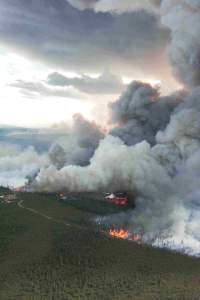
Boundary Fire near the Canadian border 2005 (Photo: Tony Chapman, BLM Alaska Fire Service)

Will climate-driven changes in fire regime affect the Porcupine Caribou Herd? Caribou actively seek out and rely on high-energy lichen-rich habitats in the winter, and these lichen stands–also known as “caribou moss”– are uniquely sensitive to fire, requiring 60-100 years to recover after burning. Alaska climate modelers and biologists teamed up to study predicted annual acreage burned in the ranges of two northern herds: the Central Arctic Herd and the Porcupine Caribou Herd (of Arctic National Wildlife Refuge fame). Using newly developed models of wildfire response to climate changes, Gustine et al. (2014) modeled burn acreage in the next few decades under two possible climate trajectories: let’s call them “warm” or “hot”. Under the “warm” scenario they found little change through 2090 in the total old-growth habitats available to caribou of either herd. However, the “hot” climate scenario indicated fires grew larger, increasing average area of winter habitat that burned per decade. In brief, the Central Arctic Herd lost 11% of their winter habitat and the Porcupine Herd lost 21% through 2090 under the “hot” scenario. In addition, 30% of the Porcupine Herd’s current spruce forest habitat changed to a younger forest type or tundra. While biologists continue to debate how much habitat is required to sustain herds at present levels, habitat loss is rarely beneficial and availability of old-growth lichen stands is a big driver of caribou use patterns in most Alaska herds. If we humans have the power to rein in the pace of climate change to the “warm” scenario by slowing our greenhouse gas emissions, the caribou would probably appreciate it. This short illustrated paper is open access—read the whole research article at:

http://journals.plos.org/plosone/article?id=10.1371/journal.pone.0100588

Citation: Gustine, D.D., Brinkman, T., Lindgren, M., Schmidt, J.I., Rupp, T.S., and Adams, L.G., 2014, Climate-driven effects of fire on winter habitat for caribou in the Alaskan-Yukon Arctic: PLOS One, v. 9, no. 7 100588, doi:10.1371/journal.pone.0100588

What is the Weather Outlook for Early Season 2015?

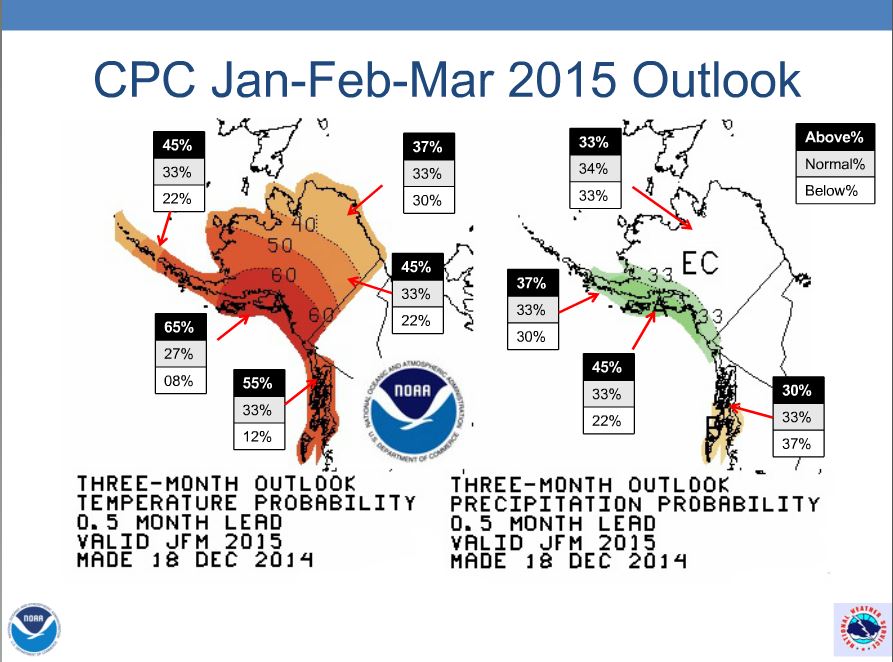
Rick Thoman, NWS Climate Scientist in Fairbanks, said “Save this one!” when he showed this slide about the CPC’s spring temperature prediction in his Dec. 19 NWS Webinar.  So I did:  it’s a pretty bold forecast for a warmer than normal early spring in much of Alaska.  Of course, it’s still hard to know what that might mean for fire season.  We know that warmer springs can be associated with premature disappearance of snow and higher fire danger in that pre-greenup season though.  On the other hand, well-timed spring rain, after the ground thaws enough to receive it, can just as easily put a damper on duff fuel moistures well into the summer.  And, it’s a lot easier to predict temperature than precipitation.  Still, when I hear the starting line-up:  PDO (Pacific Decadal Oscillation) in a warm phase, a fairly robust El Niño, and warm early spring–I can’t help but think that it could be an interesting year.  It looks like Southcentral Alaska may be in the cross-hairs again too.  Check out the latest seasonal outlooks as the season progresses at CPC’s website.

December 18th NWS prediction for spring temperature/precip in Alaska.  See the latest at www.cpc.ncep.noaa.gov/products/predictions/90day/

December 18th Climate Prediction Center Forecast for spring temperature/precip in Alaska. See the latest at http://www.cpc.ncep.noaa.gov/products/predictions/90day/

What does the 2014 Funny River Fire mean for moose on the Kenai?

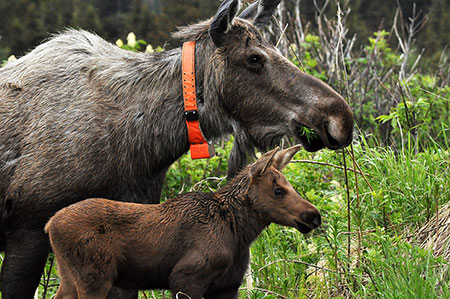
The Alaska Department of Fish and Game plans to capture 100 moose in the vicinity of the 200,000 acre Funny River Fire to monitor their response to the changes in vegetation and use of areas with different burn severities.  Past large fires in 1947 and 1969 have generally been thought to benefit moose by providing prime forage conditions during a couple decades after they burn.  Fifty moose will be fitted with GPS tracking collars to monitor movements and sensors to monitor body temperature will be used to see if recently burned areas result in “hotter” moose.  Read more about the planned research and the fire in ADF&G’s November newsletter.

Photo by Thomas McDonnough

Photo by Thomas McDonnough

Fire Improves Bison Habitat for Farewell Herd

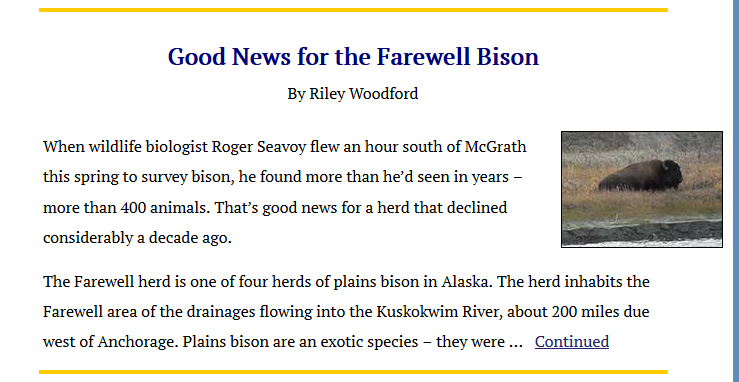
Capture-bisonIn 2010 almost 100,000 acres burned around Farewell Lakes–you may recall the “Turquoise Lake” fire.  If you’re interested to see what effect this is having on the Farewell bison herd, check the October 2014 issue of the Alaska Department of Fish and Game newsletter <HERE>.

Research Brief: New Satellite Sensors for Wildfire Mapping and Monitoring

UNIversity FORmation Mission 1--microsatellite designed by Hokkaido University for wildfire management (photo:  Koji Nakau)

UNIversity FORmation Mission 1–microsatellite designed by Hokkaido University for wildfire management (photo: Koji Nakau)

Hokkaido University (HU) is one of the world leaders in developing new earth-observing space technology. Dr. Koji Nakau leads their wildfire remote sensing applications team. He’s working with various partners—including UAF—on new satellite-derived products delivered to wildland fire managers in Alaska and around the world.  They are especially excited about the May 24th (2014) launch of a rocket carrying ALOS-2 (Advanced Land Observing Satellite) which is also carrying a couple microsatellites with sensors specifically designed by his team to detect wildfire signatures. In addition to improving real-time operational support, satellite data is analyzed in support of wildfire propagation modeling, smoke transport, fuels estimates, and post-fire ecology.

Read About the New Satellites>>  |  Download Research Brief PDF (744 kb)

Presentation on Unmanned Aerial Vehicles at UAF–Now Available!

The Alaska Center for Unmanned Aerial Systems Integration is a research center at the University of Alaska, Fairbanks for small, unmanned aircraft systems–UAVs, often referred to as “drones”– providing integration of unique payloads and supporting pathfinder missions within government and science communities–including the Fire Management Community.  ACUASI has 11 different aircraft with more coming all the time.  Deputy Director Ro Bailey gave a presentation at the Interagency Dispatchers workshop March 26, 2014 and allowed us to post her slides for those who weren’t at the meeting.  Find the presentation on Archive of Events & Webinars or link to the presentation page HERE.

2014-UAV for Interagency Dispatchers Mar26_Page_01