Webinar about Black Carbon in the Atmosphere

Tundra_Fire

National experts will be giving a talk to bring you up to speed on this issue if you’d like to know more about sources of soot in the atmosphere (including wildfire) and whether pollution control efforts are having any effect.  Speakers include: In-situ ground sensing: Patricia Quinn (NOAA);  Satellite remote sensing: Ralph Kahn (NASA); and Transport modeling: Mark Jacobson (Stanford).

Date: April 18, 2014  Time: 3:00-4:30 EDT (that’s 11:00-12:30 Alaska Daylight time)   Register at IARPC Collaboration website.

Find the recorded webinar <HERE>

The Atmosphere Collaboration Team of the Interagency Arctic Research Policy Committee (IARPC) is hosting the second of two webinars on black carbon which are open to the community. The intent of the second webinar is to share information about current science questions and activities related to Arctic black carbon. Experts will be on hand to share information and answer questions in an effort to inform the Atmosphere Collaboration Team of IARPC of possible future interagency activities related to Arctic black carbon.

Webinar Synopsis

Black carbon is “the second most important human emission in terms of its climate-forcing in the present-day atmosphere; only carbon dioxide is estimated to have a greater forcing.” When BC is deposited on snow and ice, it darkens an otherwise bright surface. The darker surface may enhance the absorption of solar radiation resulting in an acceleration of snow and ice melting. In addition, BC particles suspended in the atmosphere absorb solar radiation and heat the surrounding air. Atmospheric BC can also alter cloud properties leading to changes in cloud amount and precipitation. Black carbon has multiple sources including domestic combustion for heating and cooking, diesel combustion related to transportation, fossil fuel and biofuel combustion for power generation, agricultural burning, and wildfires. Identification of the sources and types of black carbon (both the geographical region of the source and the combustion process) is necessary for effectively mitigating its climate impacts. In addition, measurements of black carbon are required to verify whether implemented mitigation strategies that target BC emissions from certain sources are actually leading to reductions in BC concentrations in the Arctic atmosphere and surface. In 2013, NOAA’s Arctic Report Card added a black carbon assessment to the Atmosphere Section; the primary conclusions of the assessment are that (1) the average equivalent black carbon concentrations in 2012 at locations Alert (Nunavut, Canada), Barrow (Alaska, USA) and Ny-Alesund (Svalbard, Norway) were similar to average EBC concentrations during the last decade and (2) equivalent black carbon has declined by as much as 55% during the 23 year record at Alert and Barrow (Sharma et al. 2013).


Webinar Summary: What do Forest Fires, Caribou, and Monster Truck Tires have in Common? by Matt Nolan

Dr. Matt  Nolan shared results from his recent airborne photogrammetry campaigns in Alaska, and related them to possible fire and forest management applications in a webinar on February 25, 2014.  There is now a 2-page Webinar Summary about the topic and you can also watch the recorded webinar on AFSC’s website <HERE>.  Dr. Nolan is a Research Associate Professor at UAF’s Institute of Northern Engineering with degrees in geophysics and arctic and mechanical engineering. He’sNolan-Webinar-2014-THUMB_Page_1 been pioneering new high-tech uses of an old tool—the aerial photo.  With new advances in computer processing and display technologies, airborne Digital SLR Photogrammetry is an even more powerful tool for field sciences, especially in remote areas like Alaska. Compared to LiDAR (Light Detection and Ranging, or aerial 3D laser scanning), the low cost of DSLR photogrammetry makes it more affordable to make time-series of high-resolution maps, opening up  new possibilities for analyzing and understanding changes in the environment. Forest inventory, fire fuels assessments (like canopy height), snow depth, and post-burn vegetation recovery and monitoring are just a few examples of applications that could benefit from time-series of topographic measurements on an annual, monthly, or other repeating basis.

Dowload Webinar Summary <<LINK>>

Outcomes Assessment: Have we learned anything from JFSP-sponsored fire research in Alaska?

Outcome Assessment: Four Alaska JFSP Projects

The Joint Fire Science Program is doing a nation-wide survey this spring (2014) to ask managers whether sponsored research in their respective regions has improved management decisions or is useful to fire management practices.  We started thinking about this for Alaska and prepared a 2-page review of a sample of four projects dating back to 2002 to see whether they have had any impact on management in Alaska, and what their outcomes appear to be today.  Principal investigators included Scott Rupp (UAF), Phil Higuera (University of Idaho), Dan Mann (UAF), and Teresa Hollingsworth (USFS-Fairbanks).  Read our review and see if you think these projects were indeed worthwhile!

Research Brief: Fire Severity Filters Regeneration Traits to Shape Community Assembly in Alaska’s Boreal Forest

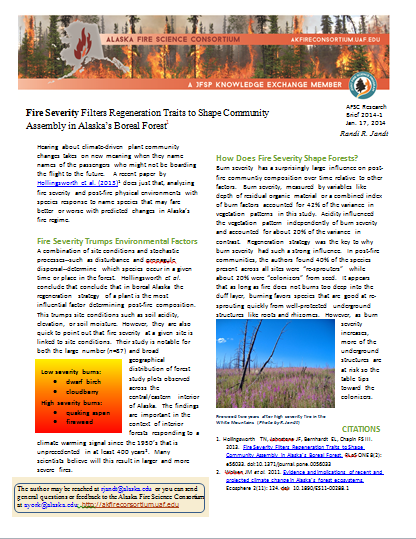
Fire Severity Filters Regeneration Traits RB-2014-1thumbto Shape Community Assembly in Alaska’s Boreal Forest:  A recent paper by Hollingsworth et al. (2013) proposes that fire severity and a plant’s intrinsic regeneration strategy are key determinants in post-fire community recovery.  The authors identify species that may fare better or worse with predicted changes in Alaska’s fire regime. Hollingsworth–who is based at the University of Alaska-Fairbanks–bases her findings on a large (n = 87) and geographically diverse set of post-fire plots in interior Alaska boreal forest.

Read More >>  |  Download Research Brief PDF (850 kb)

Research Brief: Is Alaska’s Forest Crossing a Threshold?

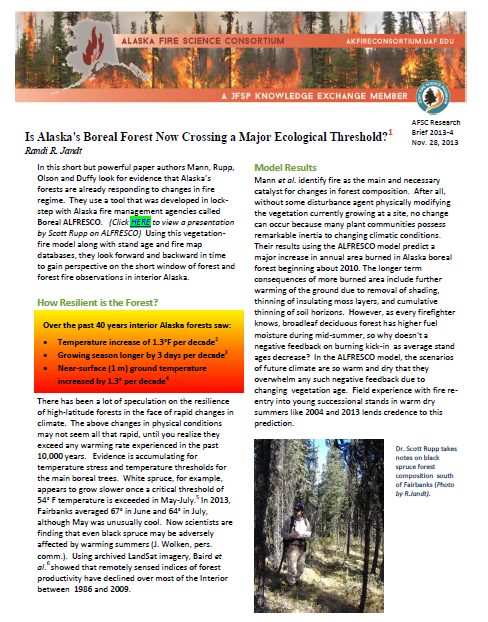
Is Alaska’s Boreal Forest Now Crossing a Major Ecological Threshold?: rb-2013-4-thumbnailRead up on what Alaskan forest and climate research has found out about the influence of warming climate on boreal forests in the Interior!  Here’s a new 2-page Research Brief that digests one of the more significant papers on forest and climate change.  The authors– Dan Mann, Scott Rupp, Mark Olson and Paul Duffy– are well-known to Alaska fire managers. This is a good basis to our upcoming focus on multi-faceted influences of dynamic climate on fire regime, forests, and fire management in Alaska in 2014!

Read More >>  |  Download PDF (861 kb)

Future global wildland fire season severity

AFSC_RB2013-3final

Global wildland fire season severity in the 21st century: A 1-page research brief summarizes a recently published article by Canadian fire scientist Mike Flannigan of the University of Alberta.  Dr. Flannigan is well-known in Alaska fire management circles due to his contributions to boreal forest wildfire studies and the Canadian large fire database.   This 2013 article describes the use of component indices of the Canadian Fuels Danger Rating System to forecast future changes in fire season severity world-wide.

Download >> | Research Brief  (pdf, 180 kb) or link to the full scientific article.

ACCAP hosted a webinar with Dr. Flannigan in July 2013. Watch the recording here.

Climate, Fire, Frost and the Carbon Bank Research Brief

CarbonBank-pub-thumb

Climate, Fire, Frost and the Carbon Bank: This 2-page research brief summarizes several years of field studies–citing recently published articles–by USGS soil scientists Jennifer Harden and Kristen Manies.  Their studies shed new light on the impact of fires on permafrost in Alaska boreal forest, and  interactions of fire effects and freezing effects on the forest floor.  The insulating moss/duff layer plays a critical role in protecting permafrost and conditions suitable for the rapid regrowth of permafrost are keys to determining whether boreal forest will retain its ability to store large amounts of biomass carbon.     Read More >>  |  Download PDF (1.5 Mb)

State of the (Alaska) Climate–What’s Really Happening to Temperature, Rainfall, Sea Ice and Fire?

ACCAPwebinarthumbnailThe latest findings on predicted vs. observed climate trends across the US were presented at a Webinar hosted by ACCAP and the National Climate Assessment Team–Alaska Chapter on March 6, 2013.  Presenters were Dr. John Walsh, a well-known weather and climate scientist from UAF, and Dr. Sarah Trainor, Director of ACCAP.   The Alaska Fire Science Consortium  recently posted a summary on the findings that are especially relevant to Alaska and to the fire management and science communities.  You can download a copy HERE.  Also, the Webinar was recorded and is still available for viewing at ACCAP’s website:  https://accap.uaf.edu/?q=webinar/national-climate-assessment-alaska-chapter

Smoke Science Plan: The Path Forward

The Joint Fire Science Program just published the September 2012 Issue of Fire Science Digest:

“Smoke Science Plan: The Path Forward”

Read it here. (Click the “Full Screen” button for the best viewing.)

Can’t access the document above?

Download the full pdf here: http://www.firescience.gov/Digest/FSdigest14.pdf

More Catastrophic Fires Ahead for Western U.S.

News from Science Daily:

More Catastrophic Fires Ahead for Western U.S..

Read the Full Journal Article:

J. R. Marlon, P. J. Bartlein, D. G. Gavin, C. J. Long, R. S. Anderson, C. E. Briles, K. J. Brown, D. Colombaroli, D. J. Hallett, M. J. Power, E. A. Scharf, M. K. Walsh. PNAS Plus: Long-term perspective on wildfires in the western USA. Proceedings of the National Academy of Sciences, 2012; DOI: 10.1073/pnas.1112839109

Direct from the Source:

Inside NAU (Northern Arizona University)