Fuel reduction projects could increase carbon emissions

Photo from Oregon State University

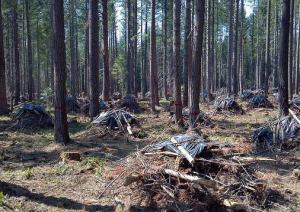
Forest thinning, such as this work done in the Umpqua National Forest in Oregon, may be of value for some purposes but will also increase carbon emissions to atmosphere, researchers say. (Photo courtesy of Oregon State University)

News from Science Daily:

Forest health versus global warming: Fuel reduction likely to increase carbon emissions.

Read the full Journal Article:

John L Campbell, Mark E Harmon, Stephen R Mitchell. Can fuel-reduction treatments really increase forest carbon storage in the western US by reducing future fire emissions? Frontiers in Ecology and the Environment, 2011; : 111215051503003 DOI: 10.1890/110057

Direct from the Source:

Oregon State University News

Local Alaskan Scientist Featured in New York Times: “As Permafrost Thaws, Scientists Study the Risks”

Methane Hot Spots, South Central Alaska, January 2010 (Photo by Marie-Laure Geai)

Local scientist Katey M. Walter Anthony (Aquatic Ecosystem Ecologist at UAF) has been studying the amount of methane gas being released into the atmosphere from thawing permafrost. As long frozen plants and other organic materials begin to thaw, they also begin to decay, producing methane gas. Katey has been collecting gas samples from frozen “bubbling” lakes near Fairbanks, Alaska to see just what we’re up against.

Continue reading →

“Projected Vegetation and Fire Regime Response to Future Climate Change in National Parks in Interior Alaska”

Excerpt from: Loya, W., Springsteen, A., Barnes, J., and S. Rupp. Projected Vegetation and Fire Regime Response to Future Climate Change in National Parks in Interior Alaska. Alaska Park Science 10:1 (22-25).

Climate change presents a significant challenge to managing our natural and cultural resources. Ecological models that project effects of climate change on plants, animals, and other system components can be used by managers to understand how these effects will impact park resources.

6,000 Years of Tundra Fires in Noatak National Preserve

One of the 37 tundra fires that burned in Noatak National Preserve in the summer of 2010. The Kaluktavik River fire (Fire #561) burned more than 23,000 acres (9,300 ha) in July. Photo from Alaska Park Science.

Excerpt from: Higuera, P., Barnes, J., Chipman, M., Urban, M., and F.S. Hu. The Burning Tundra: A Look Back at the Last 6,000 Years of Fire in the Noatak National Preserve, Northwestern Alaska. Alaska Park Science 10 (1):  36-41.

Continue reading →

“Recovery After World’s Largest Tundra Fire Raises Questions”

From the Alaska Science Forum by Ned Rozell:

Four summers ago, Syndonia Bret-Harte stood outside at Toolik Lake, watching a wall of smoke creep toward the research station on Alaska’s North Slope. Soon after, smoke oozed over the cluster of buildings.

The great Anaktuvuk River tundra fire of 2007. Photo by Michelle Mack. (From Alaska Science Forum)

To read more of this article click here or visit the Alaska Science Forum website to view all of Ned’s recent articles.

What to know more?  Check out our previous post on the Anaktuvuk  River Fire with links to Michelle Mack’s research findings and other news articles.

It’s the Webinar Time of Year!

It’s that time of year again to reset from the busy summer and catch up on the latest news in fire science and management planning. Webinars are becoming the fastest and easiest way to communicate from afar.  Here’s just a glimpse of some free webinars coming your way (shown in Alaska Time):

Continue reading →

New results show “how quickly one tundra fire can reverse a half-century worth of soil-stored carbon”

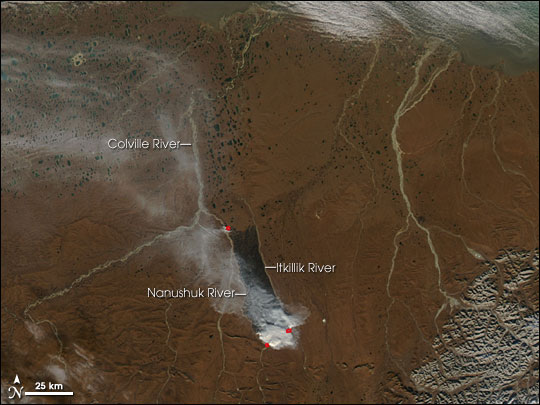
Satellite image of Anaktuvuk River Fire from Sept. 25, 2007 (NASA image courtesy the MODIS Rapid Response Team, Goddard Space Flight Center)

New findings from the 2007 Anaktuvuk River Fire revealed just how much carbon was  released into the atmosphere from this single fire and the potential role tundra fire disturbances play in feedbacks driving global climate change.

Continue reading →