Presentations available from the CFFDRS Summit in Fairbanks!

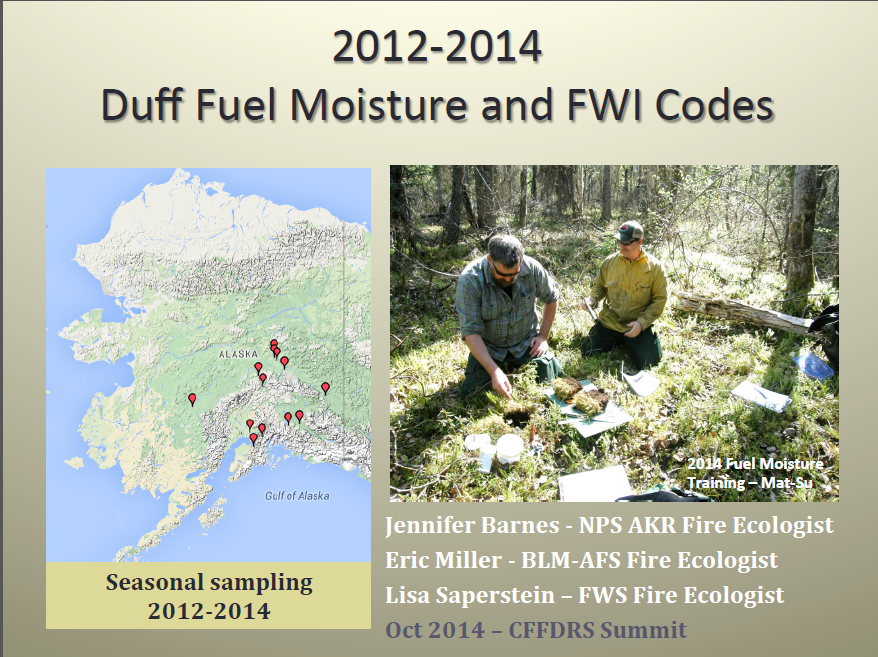
Capture-eam1
This presentation and MANY MORE available on fuel moisture sampling, remote sensing validation of FWI, new remote sensing tools for fire detection and growth modeling, using dataloggers on soil moisture probes to track fuel moisture changes, and the seasonality of CFFDRS, to name a few.

Whether you were there or missed it, the presentations and recorded videos from the  2014 Canadian Forest Fire Danger Rating System Summit held in Fairbanks October 28-30th are worth reviewing.  2014. The workshop was a great opportunity to discuss fire risk indices and fire behavior applications in Alaska and to hear how fire managers in Canada, the Great Lakes States and around the world are using the Canadian Forest Fire Weather Index System. There were over 50 managers and scientists in attendance.

Breakout group at the October 2014 CFFDRS Summit in Fairbanks

Breakout group at the October 2014 CFFDRS Summit in Fairbanks

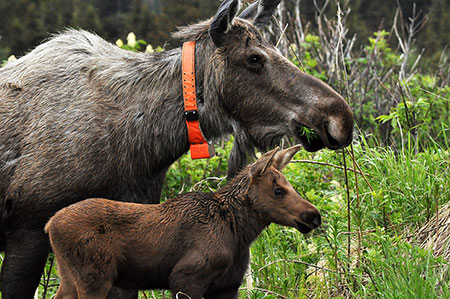
What does the 2014 Funny River Fire mean for moose on the Kenai?

The Alaska Department of Fish and Game plans to capture 100 moose in the vicinity of the 200,000 acre Funny River Fire to monitor their response to the changes in vegetation and use of areas with different burn severities.  Past large fires in 1947 and 1969 have generally been thought to benefit moose by providing prime forage conditions during a couple decades after they burn.  Fifty moose will be fitted with GPS tracking collars to monitor movements and sensors to monitor body temperature will be used to see if recently burned areas result in “hotter” moose.  Read more about the planned research and the fire in ADF&G’s November newsletter.

Photo by Thomas McDonnough

Photo by Thomas McDonnough

Warmer Permafrost–especially in Arctic Alaska

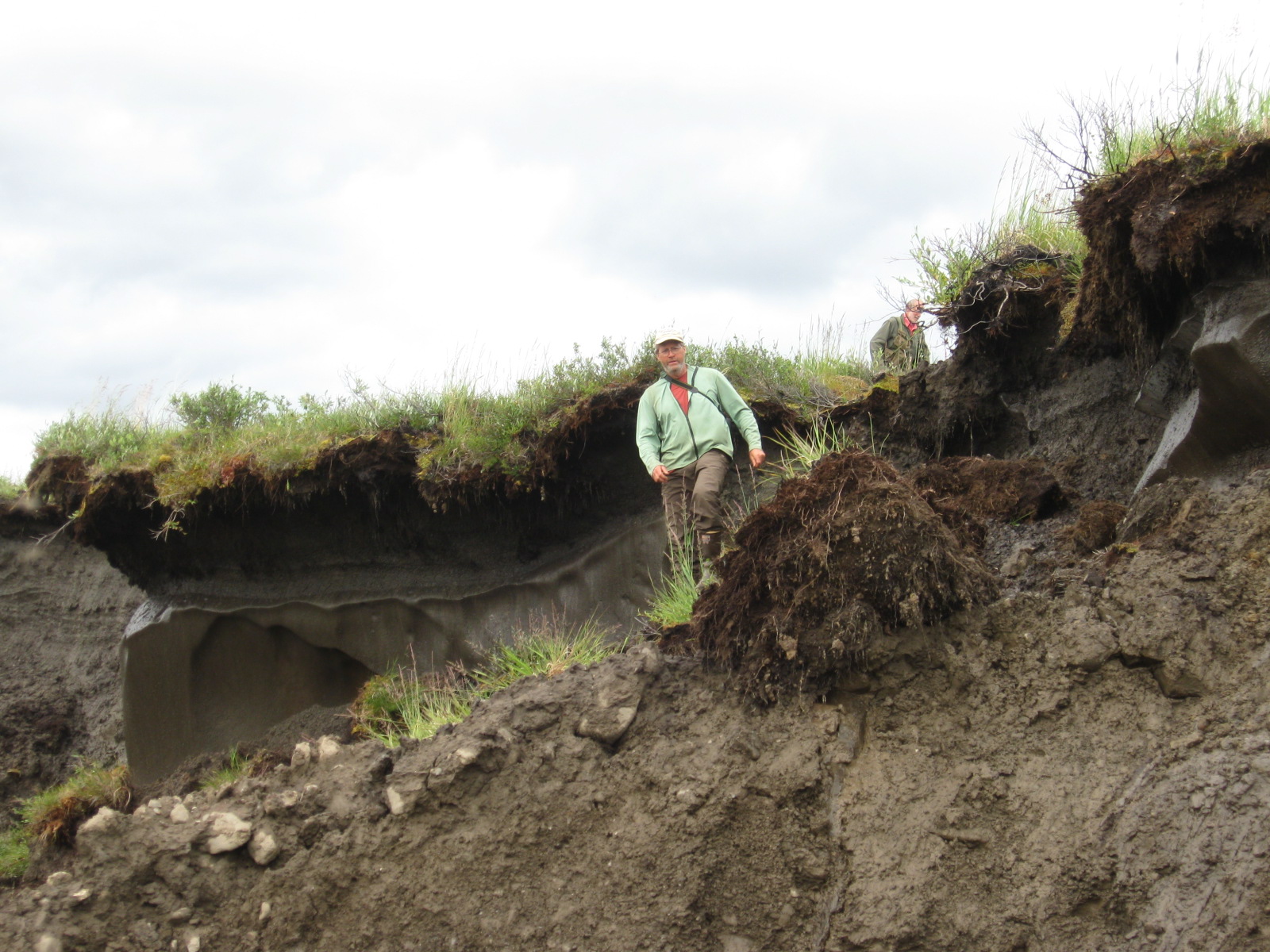
It’s hard to say what impact the recession of permafrost in the northern half of Alaska will have on fire regime.  One could presume there should be more organic moss and duff material available for combustion during the summer, which is likely to have implications for tundra fire extent and severity.  Warmer permafrost has also been linked to more extensive retrogressive thaw slumps–a kind of thermokarst which have been seen after tundra fire in ice-rich areas (photo). If you can make it, Dr. Romanovsky’s talk “Evidence of recent warming and thawing of permafrost in the Arctic and sub-Arctic, with updates on his extensive grid of permafrost monitoring wells up and down Alaska should be very interesting.  The talk is Oct 23 at Elvey Auditorium, University of Alaska-Fairbanks, at 4 pm ADT.

Photo by R. Jandt, 2010

UAF scientist Dan Mann examines fire-induced thermokarst 3 years after Anaktuvuk River fire in arctic Alaska.

Fire Improves Bison Habitat for Farewell Herd

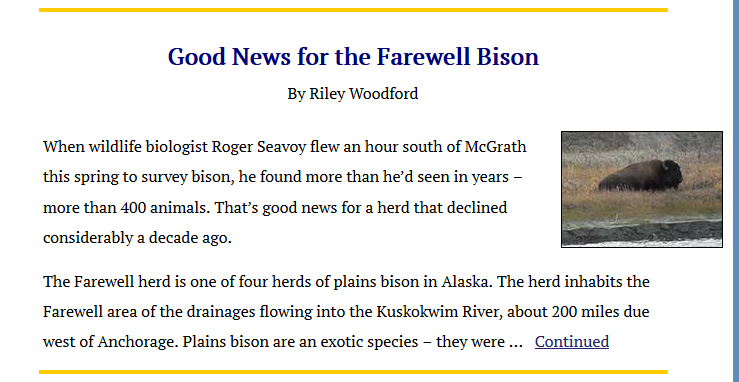
Capture-bisonIn 2010 almost 100,000 acres burned around Farewell Lakes–you may recall the “Turquoise Lake” fire.  If you’re interested to see what effect this is having on the Farewell bison herd, check the October 2014 issue of the Alaska Department of Fish and Game newsletter <HERE>.

New safety zone recommendations

Critical New Research Expands Size of Wildland Firefighter Safety Zones

The Joint Fire Science Program has supported the wildfire safety zone work of Bret Butler, a research engineer at the Missoula Fire Sciences Laboratory. Bret recently reviewed current guidelines and is leading development of new guidelines that will link slope, wind, and fire intensity to safety zone size.

A preliminary safety zone rule from this effort is now available, based on current findings relative to energy transport from wildland fire in the presence of slope and wind. The calculation is based on vegetation height rather than flame height.

Although results are preliminary and subject to change, this new research significantly expands the safety zone for many situations and should be used to provide an extra margin of safety for all wildland fire personnel.

Learn more here: http://www.firelab.org/project/firefighter-safety-zones

Click to access 07-2-1-20_Safety_zones_07112014.pdf

Graduate Thesis Defense by Aditi Shenoy

Role of fire severity in controlling patterns of stand dominance following wildfire in boreal forests

Wednesday, 25 June 2014 1:00PM
O’Neill Bldg, rm 201, Vera Alexander Learning Center, UAF
(If you can’t make it live, we hope to post a recording)
http://www.iab.uaf.edu/

Research Brief: New Satellite Sensors for Wildfire Mapping and Monitoring

UNIversity FORmation Mission 1--microsatellite designed by Hokkaido University for wildfire management (photo:  Koji Nakau)

UNIversity FORmation Mission 1–microsatellite designed by Hokkaido University for wildfire management (photo: Koji Nakau)

Hokkaido University (HU) is one of the world leaders in developing new earth-observing space technology. Dr. Koji Nakau leads their wildfire remote sensing applications team. He’s working with various partners—including UAF—on new satellite-derived products delivered to wildland fire managers in Alaska and around the world.  They are especially excited about the May 24th (2014) launch of a rocket carrying ALOS-2 (Advanced Land Observing Satellite) which is also carrying a couple microsatellites with sensors specifically designed by his team to detect wildfire signatures. In addition to improving real-time operational support, satellite data is analyzed in support of wildfire propagation modeling, smoke transport, fuels estimates, and post-fire ecology.

Read About the New Satellites>>  |  Download Research Brief PDF (744 kb)

Abstract deadline extended to May 15 for Wildland Fire Canada 2014

Wildland Fire Canada 2014
October 7-9th, 2014
Marriott Harbourfront Hotel, Halifax, Nova Scotia
WildlandFireCanada.ca
 
The Program Committee has extended the deadline for abstracts to May 15. The committee is currently accepting abstracts on, but not limited to, the following:
•Historic Fires – Learning from Our Past
•Risk Management and Multiple Disturbances in a Changing Climate
•Fire and the Natural Resource and Utilities Sectors
•Society and Fire
•Accountability at the Local, Provincial, National and International Levels

Abstract submission instructions at wildlandfirecanada.ca (note that the site still shows a deadline of April 15, hopefully this will be updated shortly).

Presentation on Unmanned Aerial Vehicles at UAF–Now Available!

The Alaska Center for Unmanned Aerial Systems Integration is a research center at the University of Alaska, Fairbanks for small, unmanned aircraft systems–UAVs, often referred to as “drones”– providing integration of unique payloads and supporting pathfinder missions within government and science communities–including the Fire Management Community.  ACUASI has 11 different aircraft with more coming all the time.  Deputy Director Ro Bailey gave a presentation at the Interagency Dispatchers workshop March 26, 2014 and allowed us to post her slides for those who weren’t at the meeting.  Find the presentation on Archive of Events & Webinars or link to the presentation page HERE.

2014-UAV for Interagency Dispatchers Mar26_Page_01


Invitation to participate in the Joint Fire Science Program Knowledge Exchange Evaluation

You are invited to participate in the national evaluation of the JFSP fire science consortia. We hope you can take the time to fill out the survey – getting a variety of responses really does help to justify our program’s ongoing funding, and getting your feedback helps us to do our job more effectively. Thanks for taking the time. The survey link is:
https://www.surveymonkey.com/s/MN92YNB

If you were at AFSC’s workshop last week, you heard us offer a chance to win “fabulous” prizes for responding to the survey. Sorry to report we just learned that offer conflicts with the survey protocol, so please do NOT notify us that you have answered the survey. But we will offer chances for “fabulous” prizes to folks who like the AFSC Facebook page before April 28. Thanks!


Here’s the official invitation from the evaluation team at University of Nevada:
We invite you to participate in the continuing evaluation of the Joint Fire Science Knowledge Exchange Program. This web-based survey focuses on the communication and application of fire science research results and resources. We are specifically interested in knowing about your opinions and experiences with the Fire Science Consortium in your region. This project is based out of the University of Nevada, Reno and includes all of the JFSP Consortia around the country. Your responses will be used to help the JFSP Consortia address your fire science information needs and ultimately enhance fire science delivery.

The survey will take approximately 10 to 15 minutes to complete. We realize that some of you may have completed a version of this survey in the past. Continued participation of prior respondents and participation from new respondents is essential in helping the JFSP consortia progress towards their goals. Your participation in this study is voluntary, and all of your responses will remain completely confidential. Please click on the following link or copy  and paste the link into your web browser:

https://www.surveymonkey.com/s/MN92YNB

If you have any questions or problems accessing the survey, please contact Evaluation Coordinator Lorie Sicafuse at lsicafuse@unr.edu, telephone (775) 327-2397.

Thank you for your time and involvement in helping us learn more about how to improve fire science delivery and communication in your region.

Loretta Singletary, Ph.D., Extension Educator and Professor, University of Nevada Cooperative Extension (singletaryl@unce.unr.edu)

Bill Evans, Ph.D., Professor of Educational Psychology, Counseling, and Human Development, University of Nevada, Reno (wevans@unr.edu)

Lorie Sicafuse, Doctoral Candidate, Interdisciplinary Social Psychology, University of Nevada, Reno (lsicafuse@unr.edu)

Lisa Maletsky, MPH, Doctoral Student, Interdisciplinary Social Psychology, University of Nevada, Reno (lmaletsky@unr.edu)

Please forward this information to any other fire science personnel or community members who can help us learn more about fire science information needs and science delivery activities in your region. Thank you!