November 2011 Fire Science Publications

Can’t seem to stay up to date?  Let us do some of the work. 

We’ve put together a bibliography of November’s (plus or minus a few weeks) new fire science publications related to Alaska and the boreal forest.  Download a simple bibliography or an annotated version, both in a pdf format including URLs for each reference.  Just want the highlights? We showcased a few of our “Top Picks” below. 

November 2011 Fire Publications – Bibliography (pdf)

November 2011 Fire Publications – Annotated Bibliography (pdf)

Our “Top Picks”

Werth, Paul A.; Potter, Brian E.; Clements, Craig B.; Finney, Mark A.; Goodrick, Scott L.; Alexander, Martin E.; Cruz, Miguel G.; Forthofer, Jason A.; McAllister, Sara S. 2011. Synthesis of knowledge of extreme fire behavior: volume I for fire managers. Gen. Tech. Rep. PNW-GTR-854. Portland, OR: U.S. Department of Agriculture, Forest Service, Pacific Northwest Research Station. 144 p.



Continue reading

News: “Wetlands: Drying Intensifying Wildfires, Carbon Release Ninefold, Study Finds”

This new article from Science Daily summarizes findings from the first project “to investigate the effect of drainage on carbon accumulation in northern peatlands and the vulnerability of that carbon to burning.”

Read the FULL ARTICLE from Science Daily.

Read the published journal article:   M.R. Turetsky, W.F. Donahue, B.W. Benscoter. Experimental drying intensifies burning and carbon losses in a northern peatland. Nature Communications, 2011; 2: 514 DOI: 10.1038/ncomms1523

“Recovery After World’s Largest Tundra Fire Raises Questions”

From the Alaska Science Forum by Ned Rozell:

Four summers ago, Syndonia Bret-Harte stood outside at Toolik Lake, watching a wall of smoke creep toward the research station on Alaska’s North Slope. Soon after, smoke oozed over the cluster of buildings.

The great Anaktuvuk River tundra fire of 2007. Photo by Michelle Mack. (From Alaska Science Forum)

To read more of this article click here or visit the Alaska Science Forum website to view all of Ned’s recent articles.

What to know more?  Check out our previous post on the Anaktuvuk  River Fire with links to Michelle Mack’s research findings and other news articles.

New results show “how quickly one tundra fire can reverse a half-century worth of soil-stored carbon”

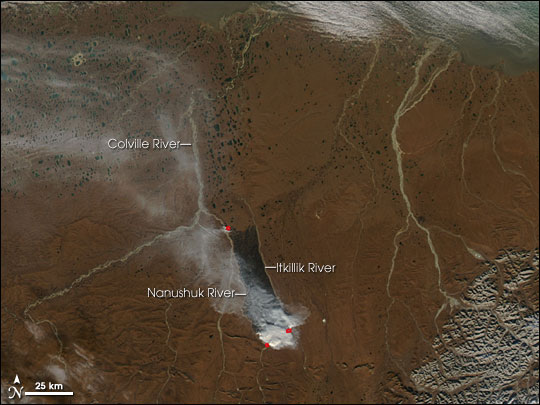
Satellite image of Anaktuvuk River Fire from Sept. 25, 2007 (NASA image courtesy the MODIS Rapid Response Team, Goddard Space Flight Center)

New findings from the 2007 Anaktuvuk River Fire revealed just how much carbon was  released into the atmosphere from this single fire and the potential role tundra fire disturbances play in feedbacks driving global climate change.

Continue reading