
 The latest findings on predicted vs. observed climate trends across the US were presented at a Webinar hosted by ACCAP and the National Climate Assessment Team–Alaska Chapter on March 6, 2013. Presenters were Dr. John Walsh, a well-known weather and climate scientist from UAF, and Dr. Sarah Trainor, Director of ACCAP. The Alaska Fire Science Consortium recently posted a summary on the findings that are especially relevant to Alaska and to the fire management and science communities. You can download a copy HERE. Also, the Webinar was recorded and is still available for viewing at ACCAP’s website: https://accap.uaf.edu/?q=webinar/national-climate-assessment-alaska-chapter
Tag Archives: climate change
New 5-yr Arctic Research Plan calls for more research on fire in Alaska’s tundra ecosystems
Fire in Alaska’s tundra ecosystems is getting more attention as a potentially important factor in climate change. A 5-yr US Arctic Research Program Plan just released by the Interagency Arctic Research Policy Committee specifically calls for investigating the frequency and severity of wildland fires in the Arctic. It mentions recent research findings from the 2007 Anaktuvuk River fire as well as the climate modeling work of SNAP and socio-economic impacts of climate change on Alaskan arctic communities. The IARPC reports to the President’s National Science and Technology Council Council who coordinates policy across agencies and set goals for Federal science and technology investments so their endorsement is potentially an important boost for researchers competing for funding. You can review the plan yourself at: http://www.whitehouse.gov/sites/default/files/microsites/ostp/2013_arctic_research_plan.pdf

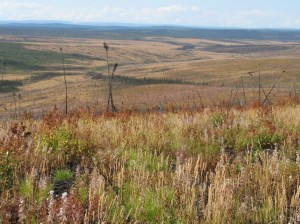
Examining fire effects in tundra 1 year after the 2007 Anaktuvuk River Fire on Alaska’s North Slope.

Tundra burning in Alaska: Rare events or harbinger of climate change? Join the Webinar!

The 2007 Uluksian Fire (photo courtesy of P. Higuera).
Dr. Philip Higuera (assistant professor at the College of Natural Resources, University of Idaho) will be joining us for a webinar on May 24, 2012 (1:00-2:00 pm AKDT) entitled “Tundra burning in Alaska: Rare event of harbinger of climate change?”. Philip’s current research is focused on how climate, vegetation, and human activities interact with fire occurrence and fire regimes (from across years to across millenia). He is also the Director of the Paleoecology and Fire Ecology Lab where students and researchers work on charcoal and pollen analysis in lake-sediment records, dendrochronology, and spatially-explicit modeling and analyses for areas in the US Rocky Mountains, Alaska, and abroad in Tasmania, Australia.
Link to recording <HERE>
Webinar at a Glance:
Dr. Philip Higuera will be presenting results from past and ongoing research focused on understanding the causes and consequences of tundra burning in the past, present, and future. The talk will integrate several lines of work, including reconstructing tundra fire history in the recent and distant past (2000-14,000 yr), quantifying relationships among modern climate, vegetation, and tundra burning, and anticipating future tundra burning given future climate scenarios.

Once Burned, Twice Shy: Webinar Wrap Up
Here’s a big Thank You to everyone who attended last week’s webinar “Once burned, twice shy”, presented on Feb. 23rd. For those who could not attend or who have been eagerly awaiting the follow up materials, please feel free to explore the videos, documents and links below. (For more information, see our previous post on this webinar.)
In Summary
(Slides by Dr. Carissa Brown.)

Once burned, twice shy: Repeat fires result in black spruce regeneration failure (Webinar)
A re-burned fire with little to no black spruce regeneration, 2007. Photo courtesy of C. Brown.
Dr. Carissa Brown, Postdoctoral Researcher at the University of Sherbrooke, will be joining us for a webinar on February 23, 2012 (11:00 am to noon AKST) entitled “Once burned, twice shy: Repeat fires result in black spruce regeneration failure.” Dr. Brown is currently studying plant species and communities at the edge of their range, focusing on the direct and indirect effects of climate change on species distribution at northern latitudes. Most recently, her work has focused on the responses to altered fire frequency at the northern margin of the boreal forest, particularly in black spruce forests.
Link to recording <HERE>
Rapid rise in wildfires in large parts of Canada? Ecologists find threshold values for natural wildfires

"A rapid rise in wildfires has been predicted for a large part of Canada" (Credit:Evgeny Dubinchuk/Fotolia) (Photo from Science Daily)
News from Science Daily:
Read the Journal Article behind this summary:
1. Richard D. Zinck, Mercedes Pascual, Volker Grimm. Understanding Shifts in Wildfire Regimes as Emergent Threshold Phenomena. The American Naturalist, 2011; 178 (6): E149 DOI: 10.1086/662675

Local Alaskan Scientist Featured in New York Times: “As Permafrost Thaws, Scientists Study the Risks”

Methane Hot Spots, South Central Alaska, January 2010 (Photo by Marie-Laure Geai)
Local scientist Katey M. Walter Anthony (Aquatic Ecosystem Ecologist at UAF) has been studying the amount of methane gas being released into the atmosphere from thawing permafrost. As long frozen plants and other organic materials begin to thaw, they also begin to decay, producing methane gas. Katey has been collecting gas samples from frozen “bubbling” lakes near Fairbanks, Alaska to see just what we’re up against.
November 2011 Fire Science Publications
Can’t seem to stay up to date? Let us do some of the work.
We’ve put together a bibliography of November’s (plus or minus a few weeks) new fire science publications related to Alaska and the boreal forest. Download a simple bibliography or an annotated version, both in a pdf format including URLs for each reference. Just want the highlights? We showcased a few of our “Top Picks” below.
November 2011 Fire Publications – Bibliography (pdf)
November 2011 Fire Publications – Annotated Bibliography (pdf)
Our “Top Picks”
 Werth, Paul A.; Potter, Brian E.; Clements, Craig B.; Finney, Mark A.; Goodrick, Scott L.; Alexander, Martin E.; Cruz, Miguel G.; Forthofer, Jason A.; McAllister, Sara S. 2011. Synthesis of knowledge of extreme fire behavior: volume I for fire managers. Gen. Tech. Rep. PNW-GTR-854. Portland, OR: U.S. Department of Agriculture, Forest Service, Pacific Northwest Research Station. 144 p.

New Video on Climate and Fire in Alaska
Watch this new video on Climate and Fire in Alaska, featuring Dr. Scott Rupp, UAF Professor, and Jennifer Barnes, NPS Fire Ecologist!
This video is 1 of a 5 part video series entitled Climate Change Watch (produced by Frontier Scientists and Wonder Visions). The Climate Change Watch series includes the following videos: Classrooms for Climate, Changing Biomes (In Production), Hydrology (In Production), Permafrost (In Production), and Fire in Alaska.
2012 Fellowship available for Masters and PhD students interested in climate change research in National Parks
Applications for the 2012 NPS George Melendez Wright Climate Change Fellowship are now open.
 AK Fire Science Highlights