How much carbon is released by tundra fires?

A recent paper by Lucas Diaz, et al. (2026) builds upon previous work to more accurately estimate the carbon impact of southwest Alaska tundra fires. When Moubarak, et al. 2023 studied the after-effects of the 2015 tundra fires, they found that 910,000 metric tons of carbon were released in emissions alone from the 134,000 acres of fires in that region. More recently, Diaz’ team studied the 2022 Apoon Pass/East Fork fires in southwest Alaska using similar methods to tie field measurements to satellite-generated burn severity metrics. Just these two fires in 2022 released the carbon equivalent of 6,876,178 barrels of oil, not counting any post-fire release due to permafrost thaw, nor the carbon footprint of the fire suppression efforts. Tussock tundra emitted an average of 1.59 ± 0.55 kg C m−2 during combustion. In 2022 burn depth averaged 7 cm, so only 11% of the total pre-fire carbon stock was consumed–mostly duff organic soil. These estimates compare favorably with Moubarak’s earlier findings of 1.68 kg C m−2 for the 2015 tundra fires. Moubarak further calculated that those fires would have a warming impact on the atmosphere for about 80 years, given the long residence time of CO2 in the atmosphere. Links to these Open Access articles are below:
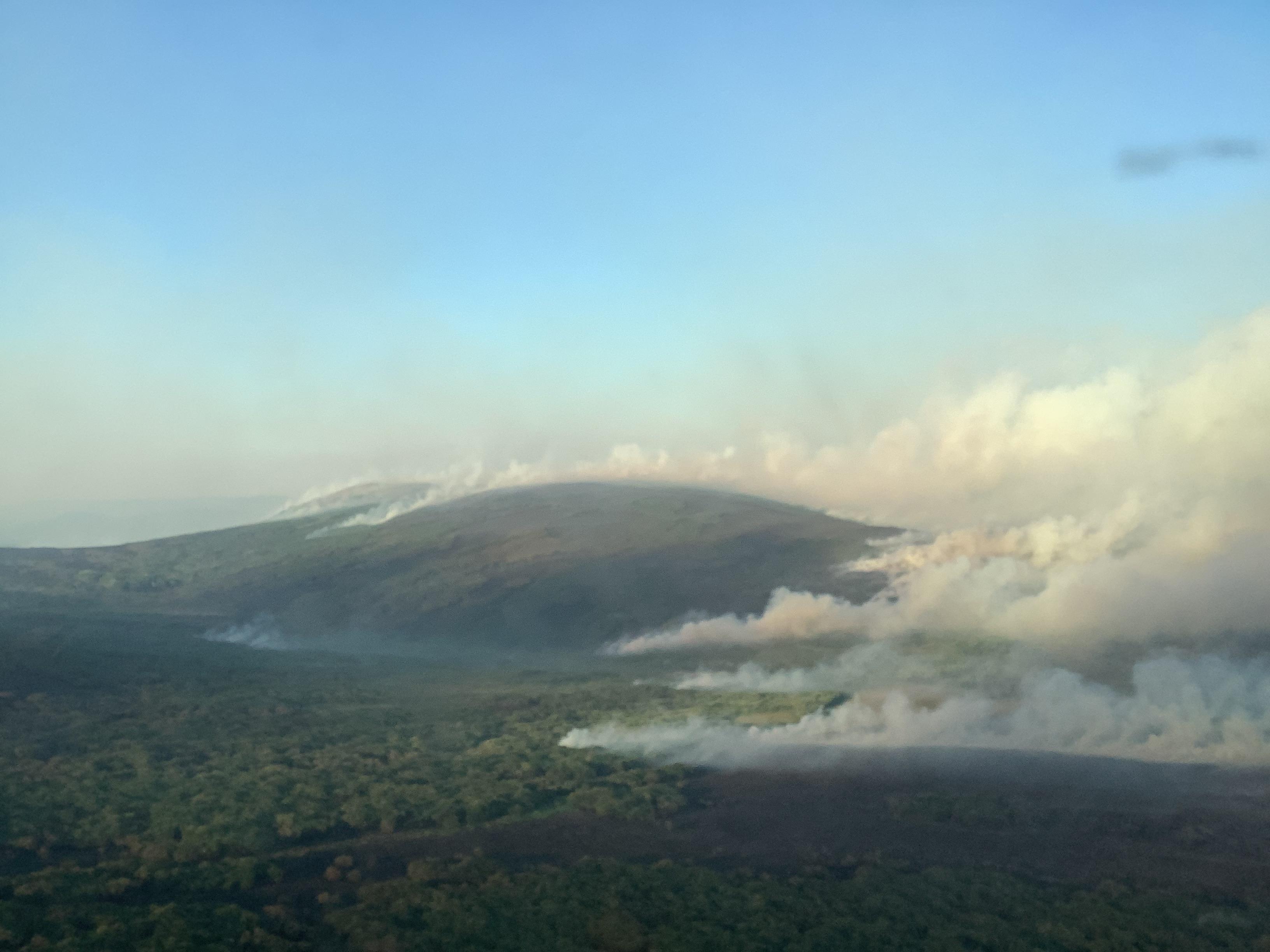
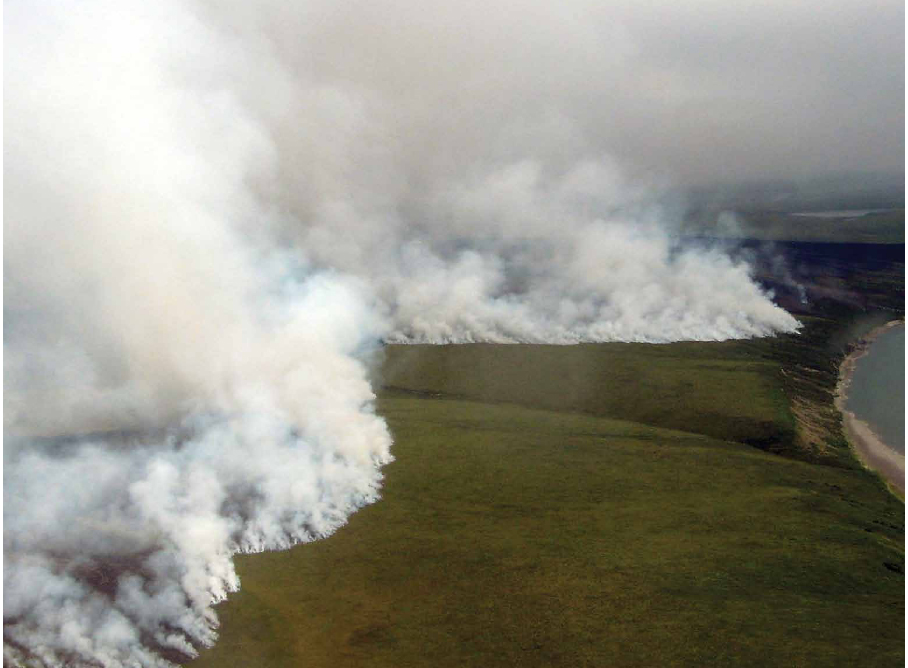
Smoke billows away from a large tundra fire as seen from the air.
Reconnaissance flight June 10, 2022, East Fork Fire in southwest Alaska. Photo: Justin Johansen.

Citations:

Diaz, L. R., Saperstein, L.B., van Gerrevink, M.J., Wangchuk, S., Hessilt, T.D., Janssen, T.A.J., Scholten, R.C., Delcourt, C.J.F. and Veraverbeke, S. 2026. Fire severity and carbon combustion from tussock tundra fires in Southwest Alaska. Environ. Res.: Climate 5 025011.

Moubarak, M., Sistla, S., Potter, S., Natali, S. M., and Rogers, B. M. 2023. Carbon emissions and radiative forcings from tundra wildfires in the Yukon–Kuskokwim River Delta, Alaska. Biogeosciences, 20, 1537–1557.

Adam Young consults the crystal ball on future fire regime across Alaska

A paper just published by the indefatigable Adam Young, a PhD candidate at the University of Idaho, and colleagues pulls together a lot of information about climate, forest, tundra and fire to offer a glimpse of potential future fire regimes in different parts of Alaska.  By looking at fire occurrence at a multi-decadal time scale, the researchers drill down into how fire rotations are likely to respond to climate projections at a regional scale.

Young Fig 6 exerpt

Exerpt from Fig. 6, Young et al. 2016. Figures in the paper not only show the observed fire rotation for 19 subregions of Alaska (Figure A2 in supplement) with 60 years of fire occurrence data, but also project future rotations under various climate scenarios (in this case a mean of of 5 global climate models).

The use of advanced statistical models to build fire-landscape response models for boreal forest and tundra reaffirms prior findings of the sensitivity of fire regime to summer temperatures and moisture deficit. However, the effect is not uniform among regions: they identify a threshold at about 56⁰ F (30-yr mean temperature of the warmest month) and another threshold for annual precipitation where fire occurrence really seems to jump.  This latter finding accounts for results which project large increases in 30-year probability of burning for areas where these thresholds will be crossed in the next several decades.  For example, models project the Brooks Range foothills of the North Slope, Noatak tundra and the Y-K Delta may see increases in fire 4-20x greater than historical levels.  Some tundra areas are likely to experience fire frequency increase to levels not observed in the paleo record, spanning the past 6,000-35,000 years.  Across most of the boreal forest, fire rotation periods are projected to be less than 100 years by end of the 21st century.  This is useful information for natural resources management as well as fire protection agencies—a concise, well-researched, well-illustrated paper—put it on your summer reading list.

Young, A. M., Higuera, P. E., Duffy, P. A. and Hu, F. S. (2016), Climatic thresholds shape northern high-latitude fire regimes and imply vulnerability to future climate change. Ecography 39: 1-12. http://dx.doi.org/10.1111/ecog.02205

Warmer Permafrost–especially in Arctic Alaska

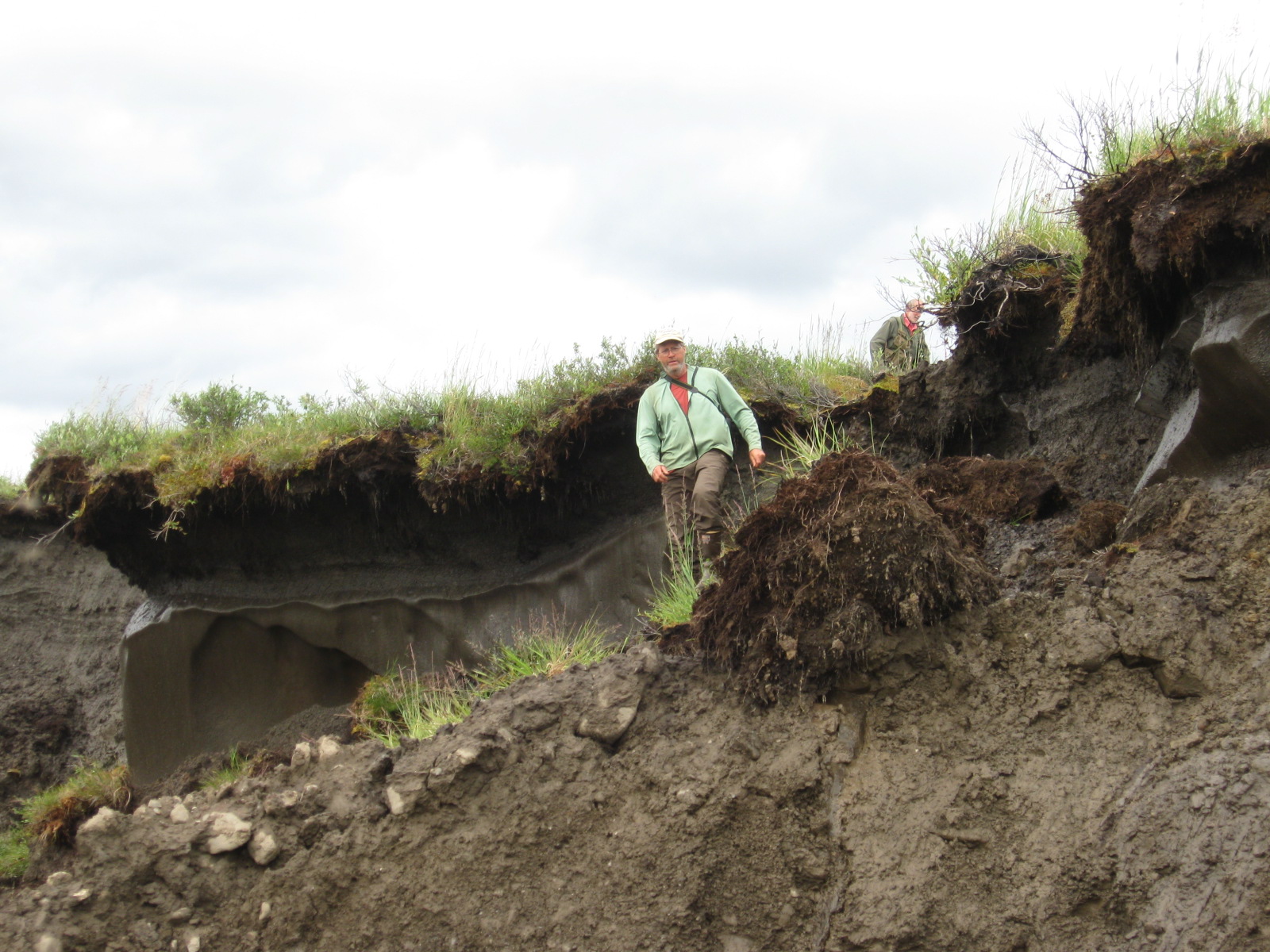
It’s hard to say what impact the recession of permafrost in the northern half of Alaska will have on fire regime.  One could presume there should be more organic moss and duff material available for combustion during the summer, which is likely to have implications for tundra fire extent and severity.  Warmer permafrost has also been linked to more extensive retrogressive thaw slumps–a kind of thermokarst which have been seen after tundra fire in ice-rich areas (photo). If you can make it, Dr. Romanovsky’s talk “Evidence of recent warming and thawing of permafrost in the Arctic and sub-Arctic, with updates on his extensive grid of permafrost monitoring wells up and down Alaska should be very interesting.  The talk is Oct 23 at Elvey Auditorium, University of Alaska-Fairbanks, at 4 pm ADT.

Photo by R. Jandt, 2010

UAF scientist Dan Mann examines fire-induced thermokarst 3 years after Anaktuvuk River fire in arctic Alaska.

Tundra burning in Alaska: Rare events or harbinger of climate change? Join the Webinar!

The 2007 Uluksian Fire (photo courtesy of P. Higuera).

Dr. Philip Higuera (assistant professor at the College of Natural Resources, University of Idaho) will be joining us for a webinar on May 24, 2012 (1:00-2:00 pm AKDT) entitled “Tundra burning in Alaska: Rare event of harbinger of climate change?”.  Philip’s current research is focused on how climate, vegetation, and human activities interact with fire occurrence and fire regimes (from across years to across millenia).  He is also the Director of the Paleoecology and Fire Ecology Lab  where students and researchers work on charcoal and pollen analysis in lake-sediment records,  dendrochronology, and spatially-explicit modeling and analyses for areas in the US Rocky Mountains, Alaska, and abroad in Tasmania, Australia.

Link to recording <HERE>

Webinar at a Glance:

Dr. Philip Higuera will be presenting results from past and ongoing research focused on understanding the causes and consequences of tundra burning in the past, present, and future. The talk will integrate several lines of work, including reconstructing tundra fire history in the recent and distant past (2000-14,000 yr), quantifying relationships among modern climate, vegetation, and tundra burning, and anticipating future tundra burning given future climate scenarios.

Continue reading

Local Alaskan Scientist Featured in New York Times: “As Permafrost Thaws, Scientists Study the Risks”

Methane Hot Spots, South Central Alaska, January 2010 (Photo by Marie-Laure Geai)

Local scientist Katey M. Walter Anthony (Aquatic Ecosystem Ecologist at UAF) has been studying the amount of methane gas being released into the atmosphere from thawing permafrost. As long frozen plants and other organic materials begin to thaw, they also begin to decay, producing methane gas. Katey has been collecting gas samples from frozen “bubbling” lakes near Fairbanks, Alaska to see just what we’re up against.

Continue reading

6,000 Years of Tundra Fires in Noatak National Preserve

One of the 37 tundra fires that burned in Noatak National Preserve in the summer of 2010. The Kaluktavik River fire (Fire #561) burned more than 23,000 acres (9,300 ha) in July. Photo from Alaska Park Science.

Excerpt from: Higuera, P., Barnes, J., Chipman, M., Urban, M., and F.S. Hu. The Burning Tundra: A Look Back at the Last 6,000 Years of Fire in the Noatak National Preserve, Northwestern Alaska. Alaska Park Science 10 (1):  36-41.

Continue reading

“Recovery After World’s Largest Tundra Fire Raises Questions”

From the Alaska Science Forum by Ned Rozell:

Four summers ago, Syndonia Bret-Harte stood outside at Toolik Lake, watching a wall of smoke creep toward the research station on Alaska’s North Slope. Soon after, smoke oozed over the cluster of buildings.

The great Anaktuvuk River tundra fire of 2007. Photo by Michelle Mack. (From Alaska Science Forum)

To read more of this article click here or visit the Alaska Science Forum website to view all of Ned’s recent articles.

What to know more?  Check out our previous post on the Anaktuvuk  River Fire with links to Michelle Mack’s research findings and other news articles.

2011 Alaska Fire Science Workshop

The 2011 Alaska Fire Science Workshop will be October 6-7 at the  BLM – Alaska Fire Service office on Fort Wainwright, AK.  This year’s workshop will cover topics ranging from new fire behavior modeling tools, to effects of changing fire regimes, to communicating fire science through art.

Continue reading

New results show “how quickly one tundra fire can reverse a half-century worth of soil-stored carbon”

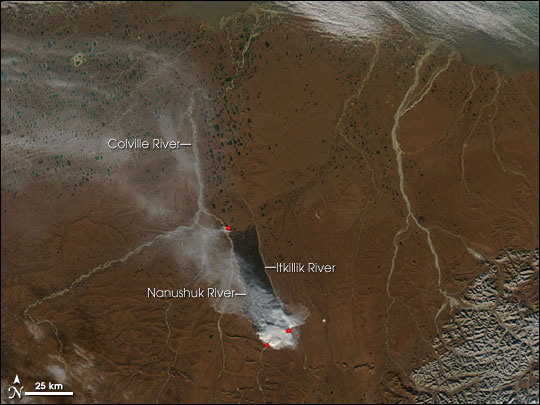
Satellite image of Anaktuvuk River Fire from Sept. 25, 2007 (NASA image courtesy the MODIS Rapid Response Team, Goddard Space Flight Center)

New findings from the 2007 Anaktuvuk River Fire revealed just how much carbon was  released into the atmosphere from this single fire and the potential role tundra fire disturbances play in feedbacks driving global climate change.

Continue reading