Do Bark Beetles Affect Fire Occurrence/Property Value on the Kenai? Watch the Video.

Hansen Thesis DefenseIf you weren’t able to hear this talk in person, watch the video posted on Alaska Fire Science Consortium website: Linked Disturbance Interactions in South-Central Alaska:  Implications for Ecosystems and People.
For his MS Thesis, Winslow explored the social and ecological implications of changing boreal forest natural disturbance regimes. He analyzed how the occurrence of spruce bark beetle outbreak has altered the probability of subsequent wildfire activity between 2001 and 2009 on the Kenai Peninsula, Alaska as well as the economic impact of fire and insect disturbances to private property values.    (By permission– Thanks Winslow!)

New 5-yr Arctic Research Plan calls for more research on fire in Alaska’s tundra ecosystems

Fire in Alaska’s tundra ecosystems is getting more attention as a potentially important factor in climate change.  A 5-yr US Arctic Research Program Plan just released by the Interagency Arctic Research Policy Committee specifically calls for investigating the frequency and severity of wildland fires in the Arctic. It mentions recent research findings from the 2007 Anaktuvuk River fire as well as the climate modeling work of SNAP and socio-economic impacts of climate change on Alaskan arctic communities.  The IARPC reports to the President’s National Science and Technology Council Council who coordinates policy across agencies and set goals for Federal science and technology investments so their endorsement is potentially an important boost for researchers competing for funding.  You can review the plan yourself at: http://www.whitehouse.gov/sites/default/files/microsites/ostp/2013_arctic_research_plan.pdf

RJ-ARF-2008

Examining fire effects in tundra 1 year after the 2007 Anaktuvuk River Fire on Alaska’s North Slope.

PNW Ecotone: New podcast series highlights research in AK, OR and WA

The USFS Pacific Northwest Research Station has recently launched the new “PNW Ecotone” podcast series.  These podcasts will cover the latest science findings, tools, and research topics from the 11 PNW laboratories and centers located in Alaska, Oregon and Washington.

Podcast episodes are available for download or streaming, along with photos, related articles, and transcripts at:  http://www.fs.fed.us/pnw/podcasts

Continue reading

Tundra burning in Alaska: Rare events or harbinger of climate change? Join the Webinar!

The 2007 Uluksian Fire (photo courtesy of P. Higuera).

Dr. Philip Higuera (assistant professor at the College of Natural Resources, University of Idaho) will be joining us for a webinar on May 24, 2012 (1:00-2:00 pm AKDT) entitled “Tundra burning in Alaska: Rare event of harbinger of climate change?”.  Philip’s current research is focused on how climate, vegetation, and human activities interact with fire occurrence and fire regimes (from across years to across millenia).  He is also the Director of the Paleoecology and Fire Ecology Lab  where students and researchers work on charcoal and pollen analysis in lake-sediment records,  dendrochronology, and spatially-explicit modeling and analyses for areas in the US Rocky Mountains, Alaska, and abroad in Tasmania, Australia.

Link to recording <HERE>

Webinar at a Glance:

Dr. Philip Higuera will be presenting results from past and ongoing research focused on understanding the causes and consequences of tundra burning in the past, present, and future. The talk will integrate several lines of work, including reconstructing tundra fire history in the recent and distant past (2000-14,000 yr), quantifying relationships among modern climate, vegetation, and tundra burning, and anticipating future tundra burning given future climate scenarios.

Continue reading

Nenana Ridge Experimental Burn Project – JFSP Final Report

The Nenana Ridge Experimental Burn Project (06-2-1-396) Final Report is now available from the Joint Fire Science Program.

In summary…

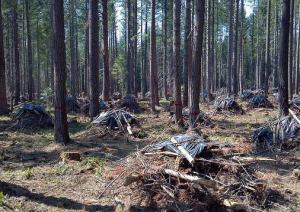
This project was funded by the Joint Fire Science Program with contributions from local, state and federal agencies. This project was designed to quantify the effects of fuels reduction treatments on fire behavior and post-fire vegetation dynamics in Alaska black spruce. The study began in 2006 with installation of four 1-acre treatment blocks. Two blocks were thinned to 8 x 8 foot spacing and limbed, one was shearbladed, and one was shearbladed and windrowed. These four blocks were replicated in the adjacent forest unit, with the intent to burn each Unit (A and B) separately. Unit A was successfully ignited on June 17, 2009.  READ MORE

Continue reading

Fuel reduction projects could increase carbon emissions

Photo from Oregon State University

Forest thinning, such as this work done in the Umpqua National Forest in Oregon, may be of value for some purposes but will also increase carbon emissions to atmosphere, researchers say. (Photo courtesy of Oregon State University)

News from Science Daily:

Forest health versus global warming: Fuel reduction likely to increase carbon emissions.

Read the full Journal Article:

John L Campbell, Mark E Harmon, Stephen R Mitchell. Can fuel-reduction treatments really increase forest carbon storage in the western US by reducing future fire emissions? Frontiers in Ecology and the Environment, 2011; : 111215051503003 DOI: 10.1890/110057

Direct from the Source:

Oregon State University News

Local Alaskan Scientist Featured in New York Times: “As Permafrost Thaws, Scientists Study the Risks”

Methane Hot Spots, South Central Alaska, January 2010 (Photo by Marie-Laure Geai)

Local scientist Katey M. Walter Anthony (Aquatic Ecosystem Ecologist at UAF) has been studying the amount of methane gas being released into the atmosphere from thawing permafrost. As long frozen plants and other organic materials begin to thaw, they also begin to decay, producing methane gas. Katey has been collecting gas samples from frozen “bubbling” lakes near Fairbanks, Alaska to see just what we’re up against.

Continue reading

“Projected Vegetation and Fire Regime Response to Future Climate Change in National Parks in Interior Alaska”

Excerpt from: Loya, W., Springsteen, A., Barnes, J., and S. Rupp. Projected Vegetation and Fire Regime Response to Future Climate Change in National Parks in Interior Alaska. Alaska Park Science 10:1 (22-25).

Climate change presents a significant challenge to managing our natural and cultural resources. Ecological models that project effects of climate change on plants, animals, and other system components can be used by managers to understand how these effects will impact park resources.

6,000 Years of Tundra Fires in Noatak National Preserve

One of the 37 tundra fires that burned in Noatak National Preserve in the summer of 2010. The Kaluktavik River fire (Fire #561) burned more than 23,000 acres (9,300 ha) in July. Photo from Alaska Park Science.

Excerpt from: Higuera, P., Barnes, J., Chipman, M., Urban, M., and F.S. Hu. The Burning Tundra: A Look Back at the Last 6,000 Years of Fire in the Noatak National Preserve, Northwestern Alaska. Alaska Park Science 10 (1):  36-41.

Continue reading

“Recovery After World’s Largest Tundra Fire Raises Questions”

From the Alaska Science Forum by Ned Rozell:

Four summers ago, Syndonia Bret-Harte stood outside at Toolik Lake, watching a wall of smoke creep toward the research station on Alaska’s North Slope. Soon after, smoke oozed over the cluster of buildings.

The great Anaktuvuk River tundra fire of 2007. Photo by Michelle Mack. (From Alaska Science Forum)

To read more of this article click here or visit the Alaska Science Forum website to view all of Ned’s recent articles.

What to know more?  Check out our previous post on the Anaktuvuk  River Fire with links to Michelle Mack’s research findings and other news articles.