Upcoming webinar: 2013 Alaska Fire Modeling Lessons Learned and Review


Lisa Saperstein, USFWS, Brian Sorbel, NPS, and Robert Ziel, DOF

Wed, March 5, 10:00 am AK time. Register.

Find the recording <HERE>

Organized by the Alaska Fire Modeling and Analysis Committee, this webinar will take a look back at some of the modeling work that occurred in 2013, specifically focused on lessons learned that can be carried forward into 2014. We expect plenty of opportunity for questions and discussion. Target audience would be Alaska fire modelers or anyone with an interest in fire modeling in Alaska.

Image: 7 day fire spread probability of Lime Hills fire, June 24, 2013, and June 30 perimeter (black line). Courtesy Lisa Saperstein.

Upcoming webinar: What do Forest Fires, Caribou, and Monster Truck Tires have in Common?

Tues, Feb 25, 10:00 am AK time. Register.

Link to recording <HERE>

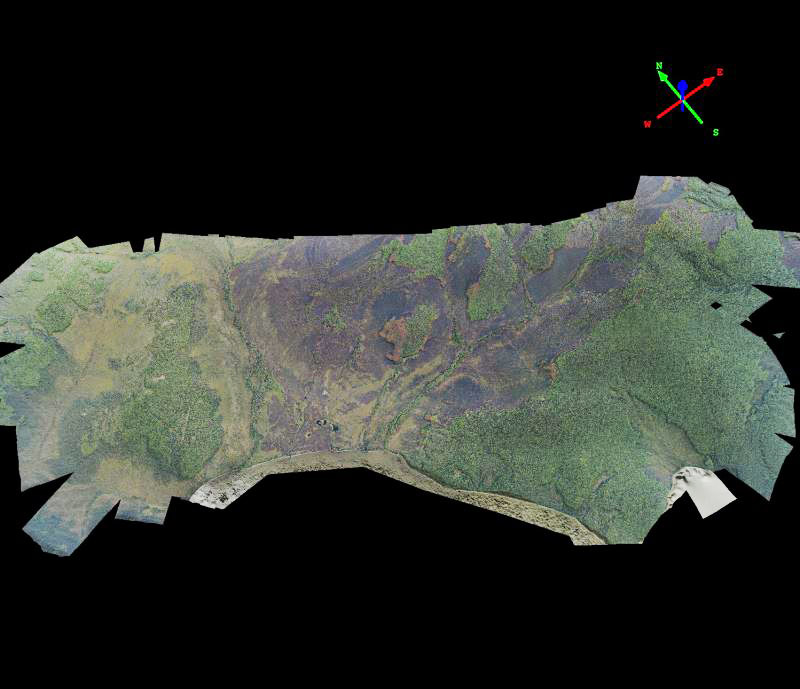
Please join us for a very exciting chance to hear Matt Nolan of the UAF Water & Environmental Research Center, who will share results from his recent airborne DSLR photogrammetry campaigns throughout the Alaskan Arctic and the Fairbanks area.  Advances in camera, GPS, and processing technologies over just the past few years have enabled Matt to put together a relatively inexpensive photogrammetry system that is easy, fast, accurate, and precise with no ground control. Compared to lidar, the low cost of DSLR photogrammetry means that it is now affordable to make time-series of high-resolution maps, and such time-series open up many new possibilities for analyzing and understanding changes in the environment, including topography, vegetation, and disturbance.
How could these new capabilities help fire managers and researchers?

See examples of Matt’s campaigns at http://www.drmattnolan.org/photography/2013/#

Image: Orthomosaic of Beaver Log Lakes fire scar near Lake Minchumina, 2013, courtesy Matt Nolan.
Image

Research Brief: Fire Severity Filters Regeneration Traits to Shape Community Assembly in Alaska’s Boreal Forest

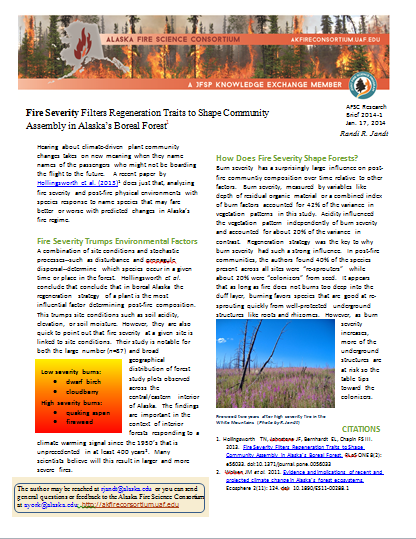
Fire Severity Filters Regeneration Traits RB-2014-1thumbto Shape Community Assembly in Alaska’s Boreal Forest:  A recent paper by Hollingsworth et al. (2013) proposes that fire severity and a plant’s intrinsic regeneration strategy are key determinants in post-fire community recovery.  The authors identify species that may fare better or worse with predicted changes in Alaska’s fire regime. Hollingsworth–who is based at the University of Alaska-Fairbanks–bases her findings on a large (n = 87) and geographically diverse set of post-fire plots in interior Alaska boreal forest.

Read More >>  |  Download Research Brief PDF (850 kb)

Participate in JFSP Fuel Treatment Science Plan Survey

Your input is requested on fuel treatment research.

The Joint Fire Science Program (JFSP) has undertaken a broad scope project to determine important research needs related to fuel treatment and develop a Fuel Treatment Science Plan. This plan will affect the policy, research, and management aspects of the fuel treatment program. It will have implications across local, regional, national, and interagency planning scales; across the range of short-intermediate, and long-term temporal scales; and will assist project and/or plan development across site-specific, project, unit, landscape, regional, and national level spatial scales. Specifically, this plan will outline future relevant fuel treatment research topics for JFSP consideration.
 
In order to fully address this topic, it is necessary to identify sources and conduct thorough information gathering. As part of this effort, contact with program leaders, stakeholders, project managers, and practitioners is critically important. This questionnaire has been developed to help obtain feedback and input. It consists of questions in the areas of fuel treatment importance, barriers and impediments to implementation, tools and guidance information, and areas of future research focus.
 
You are receiving this questionnaire because your input is valued and needed. Due to governmental rules and procedures, the initial questionnaire could only be distributed to federal employees and entities. This questionnaire is being distributed through the Northern Rockies Fire Science Network and The University of Montana to permit the widest distribution across all non-federal agencies, organizations, and individuals interested in fuel treatment. Please feel free to distribute this invitation and link to other individuals that have a role, interest, and involvement with fuel treatment activities.
   
The following link provides access to the non-federal questionnaire. We would ask you to complete the questionnaire before January 31, 2014 to facilitate analysis of the results.  https://www.surveymonkey.com/s/QYVSMNL
 
In the event any federal employees receive this message and are interested in completing the questionnaire, please use the following link to access the federal version and do not use the above listed link: https://www.surveymonkey.com/s/98H9BHM  
 
Please don’t hesitate to email us with questions or comments [put “Fuel Treatment Science Plan” in the subject line].  We thank you for your interest and support for this project.
 
Vita Wright
Northern Rockies Fire Science Network
vita.wright@umontana.edu
 
Tom Zimmerman
tomzimmerma@gmail.com

AWFCG request for input

The Alaska Wildfire Coordinating Group (AWFCG) asks you to take a few moments to respond to a survey concerning the Alaska Experimental Fire Season Forecast so that AWFCG can evaluate its utility during future fire seasons in Alaska. 

https://www.surveymonkey.com/s/WNLWJ82Image

The survey will be available until February 7, 2014. Please contact Marsha Henderson for more information.


Research Brief: Is Alaska’s Forest Crossing a Threshold?

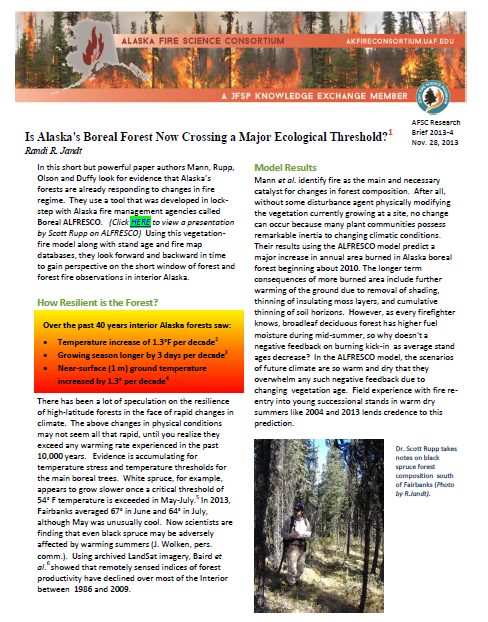
Is Alaska’s Boreal Forest Now Crossing a Major Ecological Threshold?: rb-2013-4-thumbnailRead up on what Alaskan forest and climate research has found out about the influence of warming climate on boreal forests in the Interior!  Here’s a new 2-page Research Brief that digests one of the more significant papers on forest and climate change.  The authors– Dan Mann, Scott Rupp, Mark Olson and Paul Duffy– are well-known to Alaska fire managers. This is a good basis to our upcoming focus on multi-faceted influences of dynamic climate on fire regime, forests, and fire management in Alaska in 2014!

Read More >>  |  Download PDF (861 kb)

Upcoming webinars

Please join us for 2 very interesting fire science webinars in the coming weeks. Both presentations were planned for our October Fire Science workshop, which was canceled by the government shutdown. If you cannot make the live events, the webinars will be recorded and shared on the AFSC site.

Fire Management, Fire Science, and Climate Change:
Where Do We Go From Here?
Jeremy Littell, Alaska Climate Science Center
Monday, November 25, 10 am AK time
Register now for this webinar

Link to recording <HERE>

Long-term impacts of boreal wildfire on carbon cycling dynamics in Interior Alaska
Benjamin V. Gaglioti (Water and Environmental Research Center, UAF) and
Daniel H. Mann (Geography Department, UAF)
Wednesday, December 4, 2:30 pm AK time
Register now for this webinar

Link to recording <HERE>

JFSP seeks reviewers

The Joint Fire Science Program (JFSP) needs your help to peer review the many proposals they expect to receive in response to the FY 14 Funding Opportunity Notices (FONs).

Recommendations from peer-review panels are critically important. The JFSP Governing Board uses recommendations from peer-review panels to help make funding decisions. Participation in a JFSP review panel is also a great way to improve proposal development skills.

Please consider your expertise, interests, and availability and let JFSP know if you can conduct a review. It is critical that reviewers have substantial scientific or technical expertise in the scheduled FON topic area.

Visit the AFSC website for more information about the plans for proposal review, including a schedule.

Please respond to Becky Jenison via email, no later than COB November 22 if you are willing to help, or have questions. Please indicate what task statements and dates you are available to participate, and attach a short CV.

Joint Fire Science Program proposal deadline extended

Joint Fire Science Program has extended the deadline for proposals to their currently open funding opportunity notices. The new deadline is Wednesday, December 11, 2013. See the Joint Fire Science Program website for more information.

Canceled Events October 8-11

The AFSC events planned for next week have been canceled due to the federal shutdown. We plan to identify alternative ways to share current fire science results and facilitate collaborative discussions among fire scientists and managers in the near future. Please check back soon for news on upcoming JFSP proposal planning meetings and fire science webinars.