New JFSP Brief – Rising Temps Trigger Ecological Changes in the Boreal Forest of Alaska

Key Findings:

1.  Understory or overstory Composite Burn Index (CBI) ratings for 10 fires were not substantially affected by slope aspect, and elevation, but for two of the fires, results related to timing, or burn season, were significant.

2.  Within the next 50 years, simulation results indicate that boreal forest vegetation will likely shift from primarily spruce-dominated to deciduous-dominated.

3.  Despite the shift to less flammable species, simulation results predict an increase in fire frequency and number of acres burned annually.

4.  ALFRESCO model simulations and changes in the projected cumulative area burned suggest a general rise in fire activity through the end of this century, with the most rapid change in fire activity occurring in the next 20-30 years.

READ MORE of this summary….

Continue reading

2011 Alaska Fire Science Workshop Podcasts Now Available!

This slideshow requires JavaScript.

Watch these podcasts from the 2011 Alaska Fire Science Workshop!

Continue reading

“Projected Vegetation and Fire Regime Response to Future Climate Change in National Parks in Interior Alaska”

Excerpt from: Loya, W., Springsteen, A., Barnes, J., and S. Rupp. Projected Vegetation and Fire Regime Response to Future Climate Change in National Parks in Interior Alaska. Alaska Park Science 10:1 (22-25).

Climate change presents a significant challenge to managing our natural and cultural resources. Ecological models that project effects of climate change on plants, animals, and other system components can be used by managers to understand how these effects will impact park resources.

6,000 Years of Tundra Fires in Noatak National Preserve

One of the 37 tundra fires that burned in Noatak National Preserve in the summer of 2010. The Kaluktavik River fire (Fire #561) burned more than 23,000 acres (9,300 ha) in July. Photo from Alaska Park Science.

Excerpt from: Higuera, P., Barnes, J., Chipman, M., Urban, M., and F.S. Hu. The Burning Tundra: A Look Back at the Last 6,000 Years of Fire in the Noatak National Preserve, Northwestern Alaska. Alaska Park Science 10 (1):  36-41.

Continue reading

It’s the Webinar Time of Year!

It’s that time of year again to reset from the busy summer and catch up on the latest news in fire science and management planning. Webinars are becoming the fastest and easiest way to communicate from afar.  Here’s just a glimpse of some free webinars coming your way (shown in Alaska Time):

Continue reading

New results show “how quickly one tundra fire can reverse a half-century worth of soil-stored carbon”

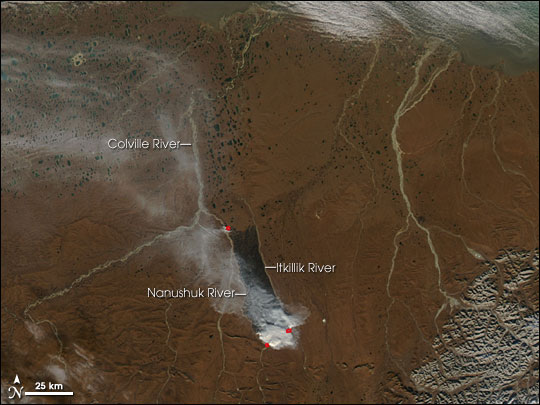
Satellite image of Anaktuvuk River Fire from Sept. 25, 2007 (NASA image courtesy the MODIS Rapid Response Team, Goddard Space Flight Center)

New findings from the 2007 Anaktuvuk River Fire revealed just how much carbon was  released into the atmosphere from this single fire and the potential role tundra fire disturbances play in feedbacks driving global climate change.

Continue reading

News from the Pacific Wildland Fire Sciences Lab

The Fire and Environmental Research Application Team (or FERA) from the USFS Pacific Wildland Fire Sciences Lab have several new products, papers, and projects to share with you!

Check out the FCCS fuelbed maps for Alaska, the Alaska boreal fire-history synthesis and lit review, and this new article on the relationship between climate and fire.

Continue reading