Fire science research in Alaska at UAF’s Long-Term Ecological Research Unit

Feature: Fire can make hardwood stands enduring

As one significant boreal research project (the NASA Arctic Boreal Variability Experiment) winds down, another important research collaboration is winding up, thanks to hard work by a group of scientists in Bonanza Creek Long-Term Ecological Research unit (BNZ-LTER).  Both projects have tackled important fire science and management issues in Alaska.  Although BNZ-LTER grew from the Bonanza Creek Experimental Forest (beginning in the 1980’s) and Caribou-Poker Creek Watershed, it’s work now expands across Alaska and western Canada and includes collaborating researchers from many locations, but especially University of Alaska and Northern Arizona University.  BNZ-LTER also welcomes broad collaboration from land and resource managers and community stakeholders. 
Click on link above for .pdf

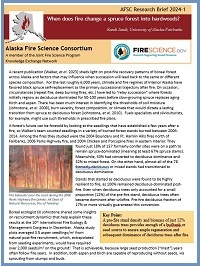
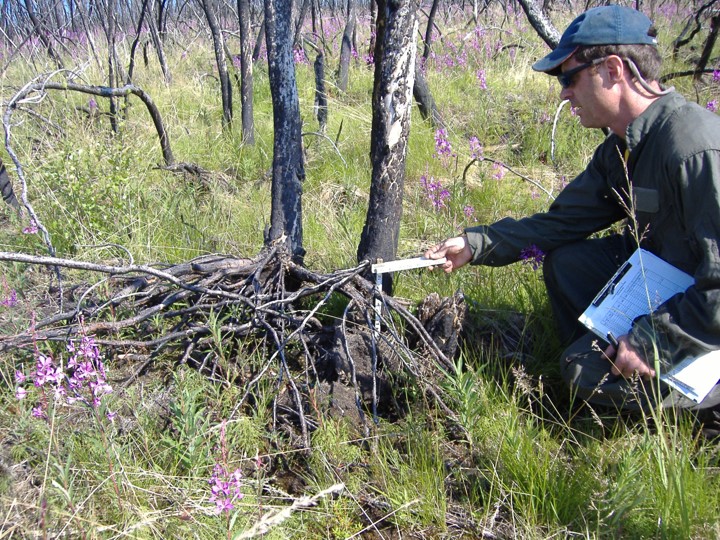
Research at the BNZ-LTER has always had a strong wildfire component.  Dr Michelle Mack leads the unit as their Principal Investigator, as well as heading Northern Arizona University’s (NAU) Plant and Ecosystem Ecology Research Lab. In May 2023, Dr. Mack and her team were awarded a renewed grant of $7.6 m from the National Science Foundation for support through 2029.  The project, titled Changing Disturbances, Ecological Legacies, and the Future of the Alaskan Boreal Forest, has several subtopics, including a Wildfire Working Group led by Dr. Xanthe Walker (NAU).  The wildfire group is studying direct and indirect effects of fire, such as seedling re-establishment, effect on soil microbes, overwintered fires and stream chemistry.  They are also studying fire management activities like fuel breaks.  One recent publication by Walker, Mack, Johnstone, and others is highlighted in our latest Research Brief:  When does fire change a spruce forest into hardwoods?  The paper discusses what has been learned from the LTER’s extensive network of post-fire forest plots on drivers and thresholds of stand-type conversions—a hot topic for a number of management applications.
Research on Large Wildfires Sheds More Light on Fuel Treatments Impacts

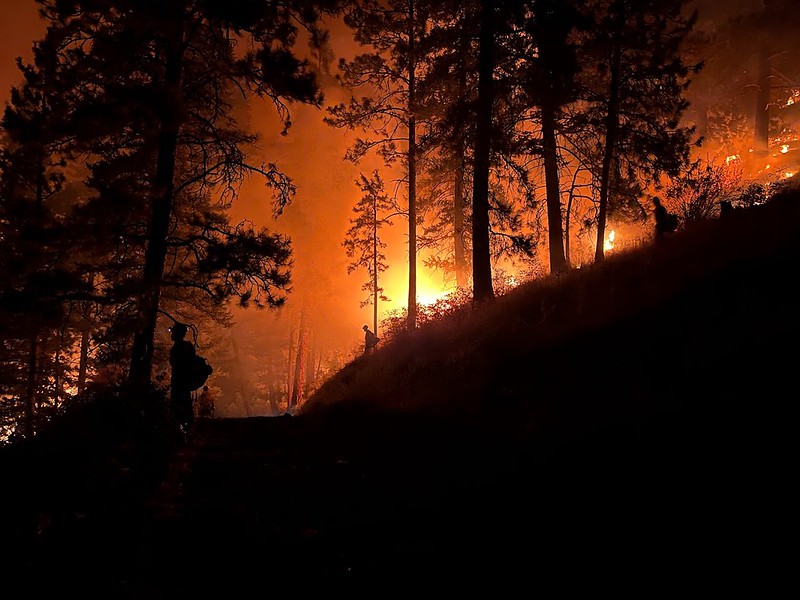
Photo credit: Midnight Sun IHC ( Night burnout operation in L48).

Fuel treatments like thinning and fuel breaks often help trees better survive wildfires in the western US but their biggest direct benefit lies with providing operational choices and opportunities to firefighting teams.  Presentations at the 10th International Fire Ecology & Management Congress this past month in Monterey outlined research on whether treating vegetation fuels before a fire threatens are “worth it”.  Alan Taylor’s team looked at fuel treatments in the 2021 Dixie fire which burned over 1,500 square miles in 5 northern California counties (suppression cost $637,000,000 but losses estimated at $1.5 billion). Research found that previous fire–within the past decade–reduced the fire severity by a third (based on tree death and damage).  There were some exceptions, where recent burns with heavy grass/brush cover got “nuked” in the re-burn under the extreme heat and drought conditions that prevailed that year.  The biggest variables correlated with increased fire severity were forest biomass (using NDVI as a proxy) and tree cover.  Variables associated with decreased severity included maximum relative humidity and fire operations.  The latter is interesting, since burnouts and backfires are a major part of strategies to combat gobbler fires like Dixie.  Taylor, a fire ecology professor at Penn State, estimated that these tactics used by firefighters reduced the area which would have burned with high severity by about 22%.  It should be noted that burnout operations in western US conifer forests are often conducted at night whereas in Alaska they are more often daytime operations. 

Another research effort led by Lacey Hankins studied the effect of previous fuel treatments on outcomes of the 2022 Washburn Fire in Yosemite National Park.  They used fire effects plot data and Lidar data but also interviewed fire operations staff to find out if previous roadside thinning or other forest management treatment shaped tactics.  Yosemite’s fuel treatments, conducted since the 1970’s, reduced forest density and fuel load—especially ladder fuels.  Operations personnel felt previous prescribed fires and strategically placed fuel treatments were key considerations in tactics and helped them protect the town and the giant sequoias in Mariposa Grove. Other presenters in the session described moderation of fire severity in shaded (thinned) treatments up to 20 years old in forests of the Sierra Nevadas, while in southern British Columbia, thinning treatments only worked to lower crowning and torching in the more aggressive treatments. Low intensity thinning (400-1,400 stems/ha) treatments did not reduce modeled fire intensity, nor did pruning (Rutherford, 2023).

—Cited Presentations—

Alan H. Taylor, et al. (2023) The contributions of past fires and fire management operations to severity patterns of the Dixie Fire, Presentation at 10th Intl Fire Congress, Monterey, CA, Dec. 5-7, 2023.

Lacey E. Hankin, et al.  (2023) Linking forest management to operational outcomes of the Washburn Fire in Yosemite National Park, Presentation at 10th Intl Fire Congress, Monterey, CA, Dec. 5-7, 2023.

Kea Rutherford, et al. (2023) Are operational fuel treatments successfully mitigating wildfire risk in British Columbia, Canada?  Presentation at 10th Intl Fire Congress, Monterey, CA, Dec. 5-7, 2023.

Does the Drought Code (DC) Accurately Track Deep Drying in Alaska?

Recent studies by experts in Alaska and Canada have given us much new insight into the Drought Code (DC) component of the Fire Weather Index System used in both places.  While other components of the FWI are simple in concept and easily validated by field observations, there have long been questions about the DC: what does it represent? How it should be interpreted and validated? How and if we should “overwinter” DC? How to convert DC to a moisture content (by weight or by volume) or vice versa?  Canadian fire scientist Chelene Krezek-Hanes recently finished her PhD thesis, which reported on her extensive field work and remote sensing experiments and has yielded four published papers so far.  Meanwhile, Alaska fire ecologist Eric Miller teamed up with University hydrology experts to validate the DC’s assumptions against field data in Alaska. Our latest Research Brief Everything you wanted to know about the Drought Code in Alaska . . . but were afraid to ask” gives highlights of some of their findings: https://www.frames.gov/sites/default/files/AFSC/AFSC/Research/Brief/2023-4-final.pdf

Western Forester Articles on Alaska!

See also p. 24 WFOctNovDec2022 for updates on fuel break projects on the Kenai by Tracy Robillard.

Please also note a great Post-Doc opportunity with one of AFSC’s collaborating scientists to study boreal climate change impacts and mitigation methods. It pays well (~$68,000 year for two years) and comes with a lot of flexibility and opportunities for global scale collaboration. The ad is here: https://www.edf.org/jobs/cooley-postdoctoral-science-fellow

Do bark beetle outbreaks really affect burning?

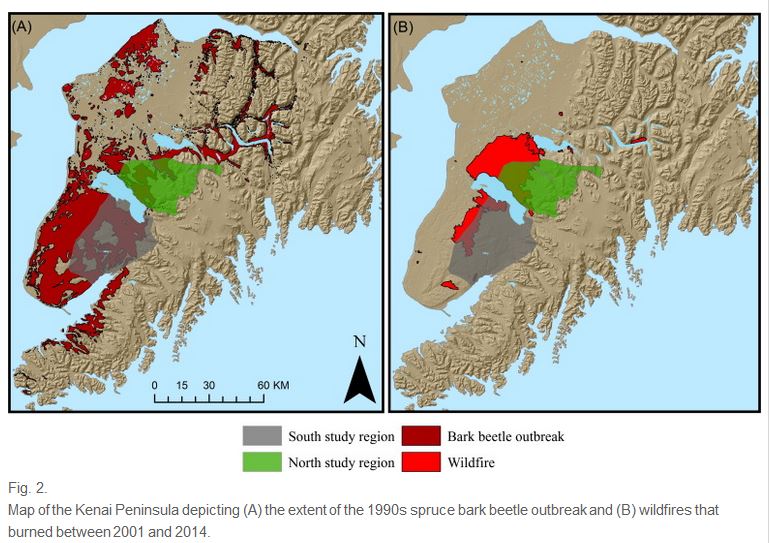
Capture-hansen2016fig2


It has long been assumed that bark beetle outbreaks on the Kenai lead to increased fire danger, even though beetle disturbance has been shown to have mixed effects on crown fire potential, fuel profiles and burn severity in the Rocky Mountains.  Winslow Hansen, doctoral candidate at the University of Wisconsin, recently published an analysis of beetle outbreaks and fire on the Kenai Peninsula between 2001-2014 (Hansen et al. 2016).  He looked at effects in pure white spruce stands–where duration of beetle attacks is longer and mortality greater–and in mixed white and black spruce stands common on the northern peninsula, where attacks are less severe.  His analysis indicates mixed effects:  severely damaged white spruce stands did not demonstrate increased fire occurrence (instead, % canopy cover appeared to drive likelihood of burning) while the mixed white/black spruce stands did show a positive correlation with beetle outbreaks and fire.  Winslow explores the reasons for this in his relatively short article:  worth reading.  You may remember Winslow from his previous work on beetles/fire effects and property values on the Kenai (recorded MS Thesis defense) and climate effects on fire regime (recorded 2015 presentation).

Citation:  Hansen, W.D, F.S. Chapin III, H.T. Naughton, T.S. Rupp, and D. Verbyla. 2016. Forest-landscape structure mediates effects of a spruce bark beetle (Dendroctonus rufipennis) outbreak on subsequent likelihood of burning in Alaskan boreal forest.  Forest Ecology and Management 369: 38–46.

Fuel Treatments Aid 2015 Firefighting Efforts in Alaska

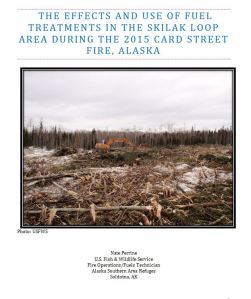
A new report by USFWS Kenai Refuge fire staff (Nate Perrine) examines

Capture-cardst

areas where the 2015 Card Street fire intersected completed fuels treatments. He utilized IFTDSS (Interagency Fuels Treatment Decision Support System) modeling to analyze the treatment effect on fire behavior, and also documented post fire effects within the treated areas. This well-illustrated discussion includes recommendations for future treatments and analyses–a must-read for fire fuels specialists in Alaska! Click below to download a pdf.

The Effects and Use of Fuel Treatments during the Card Street Fire

Webinar Dec 20th- What is Live Fuel Moisture? A New Look at the Combustion of Live Plants

Fire in PIMA LEPA_JBarnes_250x195

Image from Jennifer Barnes, National Park Service

Date: Thursday, December 20, 2012
Time: 10:00 – 11:30 AM (AK Time)

Link to recording <HERE>

Presented by:  Matt Jolly, PhD
Research Ecologist, USFS
Fire, Fuel and Smoke Science Program
Missoula Fire Sciences Laboratory

Live fuel moisture is measured frequently throughout the country as an indicator of potential fire behavior but little is known about the primary factors that drive their seasonal variations. Dr. Matt Jolly will delve into the interactive factors that control live fuel moisture and will discuss some of the potential implications of these factors on seasonal variations in the fire potential of living plants. Ultimately, he will show how the interactions between the water content of the foliage and seasonal changes in the leaf’s dry weight combine to influence calculated live fuel moisture and its flammability.

Read more about Dr. Jolly’s work with living plants and fire and the Missoula Fire Sciences Lab.

Related Resources:
Foliar moisture content input in the Canadian Forest Fire Behavior Prediction System for areas outside of Canada
Martin E. Alexander, 2010

Assessing the effect of foliar moisture on the spread rate of crown fires
Martin E. Alexander and Miguel G. Cruz, 2012

Join The Webinarr:

Click HERE to join this webinar (http://osu-pilot-conc.adobeconnect.com/dec202012/).

No pre-registration required.  This link will be active at 9:45 am AK Time on Dec 20th. Select “Enter as a Guest” and provide your name where prompted to participate.

Continue reading

2012 Alaska Fire Science Workshop Presentations Now Posted!

All of the presentations, handouts, and recordings from the 2012 Alaska Fire Science Workshop are available for viewing/download <HERE>

Click on any of the topics below to watch the recording:

This slideshow requires JavaScript.

CNN Video – Laptops Used to Predict Wildfire Movement


Watch this video to see FSPro in action.

Direct Video Link: http://cnn.com/video/data/2.0/video/us/2012/07/03/ac-pkg-savidge-fire-predictions.cnn.html

Aside

Listen to how Rod Norum faced the challenge of a major fire burning toward the Alaska Pipeline–including a “monster” tactical 26-mile-long backfire.

Direct link to this video:  http://youtu.be/2oLTxhLQd-E?t=3s

Visit the Wildland Fire Lessons Learned Center for more videos from the experts.

Learning from the experts: Watch Rod Norum discuss his experience with fuels and fire behavior in Alaska