Will Forest Change Counteract Climate-Driven Increase in Fire?

At the 2019 Fall Fire Science Workshop, we had a great presentation by Jill Johnstone on the concept of fire self-regulation in the boreal forest*.  This theory holds that as fire becomes more frequent and/or severe, spruce forests will increasingly convert to mixed and deciduous forests and provide negative feedback to burn extent even as the climate warms.

Hotspotting in Hardwoods

Fire A121, 2008, Midnight Sun Hotshots fight a fire in Alaska paper birch. (D. Jandt)

As you heard there, Jill is spearheading an effort to do a synthesis of findings of many studies in AK/Canada. At last week’s Association of Fire Ecology (AFE) Congress meeting, team member Xanthe Walker shared preliminary findings of the search for evidence of the effects of stand age and alternative vegetation types on probability of burning.  Do fires seem to “prefer” or “avoid” areas which burned in recent history?  In short, several studies across Canada, and a couple from Alaska, provide evidence for some level of self-regulation.  That begs the question:  how important are fuels vs. weather?  Will the self-regulation effect be enough to moderate the influence of higher fire indices in the future on acres burned?

Recall that fairly rigid self-regulatory feedbacks were programmed into the Boreal ALFRESCO model that has been used by Rupp, Duffy, Shultz, and others to build scenarios for Alaska’s land managers on how much burning will occur in the future and how much that will cost in suppression effort.  (See Implications of Climate and Management Options on Wildland Fire in Alaska: Exploring Future Fire Scenarios, a presentation by Courtney Schultz and Tait Rutherford at the 2017 Alaska Fall Fire Science Workshop, October 10, 2017.)  But, can we count on this?  Xanthe’s presentation (which AFSC recorded at the meeting and will soon be posting for you on our Vimeo site) concluded there will be SOME moderation of increased burning but also that these fuel effects can be overwhelmed by weather.  The latter is no surprise to fire practitioners in Alaska, i.e. young stands burn in extreme fire years and deciduous stand burn more during drought years. Quantifying this effect is what we need, and some good studies are starting to emerge.  Across the North American boreal forest, it appears that the strongest self-regulation occurs when weather is not extreme and where deciduous forests dominate to begin with.  It’s great to have a start on the answer to our burning questions about re-burn—there is clearly more to discover and we’re tickled to have this power-house team of researchers working on the problem.  You better believe we’ll be keeping in touch and watching for their publications.  We’re also happy they have welcomed the participation of agency fire ecologists and other local practitioners into the studies, because folks in the field have a lot to bring to the observational table.

*See Fire Self-Regulation, Evaluating the Current State of Understanding from Published Studies Presented by: Jill Johnstone, University of Alaska Fairbanks and University of Saskatchewan at the October 2019 AWFCG Fall Fire Review

List of selected citations used in Walker presentation: 

Beverly, J. L. 2017. Time since prior wildfire affects subsequent fire containment in black spruce. International Journal of Wildland Fire 26:919–929.  (Assesses whether stand age of black spruce forests has a detectable effect on the success of initial attack on fires <2 ha size in Alberta.)

Boulanger, Y. et al. 2017.  Changes in mean forest age in Canada’s forests could limit future increases in area burned but compromise potential harvestable conifer volumes. Canadian Journal of Forest Research 47(6): 755-764. (Modeled fire occurrence in the face of climate change with inclusion of self-regulation due to vegetation change across fire regimes of Canada.  Self-regulation substantially moderated the climate-driven fire increases but did not fully compensate for it – so fire activity will still increase even with the inclusion of these feedbacks).

Dash, C. B., J. M. Fraterrigo, and F. S. Hu. 2016. Land cover influences boreal-forest fire responses to climate change: geospatial analysis of historical records from Alaska. Landscape Ecology 31:1781–1793. (Large fires had a greater proportion of conifer forests than small fires, suggesting preferential rapid fire spread in conifer forests, but the effect of land cover on burning is less in years with extreme fire weather, when vegetation types burn at a rate close to that expected in the random model.)

Erni, S., D. Arseneault, M.-A. Parisien, and Y. Begin. 2017. Spatial and temporal dimensions of fire activity in the fire‐prone eastern Canadian taiga. Global Change Biology 23:1152–1166. (Firescar study of reconstructed 300 years of fire activity in Quebec to examine relative effects of climate/ weather vs. forest age controls on fire activity. In younger stands, burn rate was lower for up to 50 years, depending on landscape).

Hely, C., M. D. Flannigan, Y. Bergeron, and D. J. McRae. 2001. Role of vegetation and weather on fire behavior in the Canadian mixedwood boreal forest using two fire behavior prediction systems. Canadian Journal of Forest Research, v. 31, no. 3, p. 430-441.  (Compared FBP and Behave performance in boreal mixedwood in Quebec.  Although weather was overall more influential than fuel type, expected ROS was lower in deciduous that coniferous stands, and FBP performed better than Behave in this fueltype).

Parks, S. A., M.-A. Parisien, C. Miller, L. M. Holsinger, and L. S. Baggett. 2018. Fine-scale spatial climate variation and drought mediate the likelihood of reburning. Ecological Applications 28:573–586. (Fire spread was retarded by presence of previous fires for about 33 years in Wood Buffalo Park, Alberta, but the drought reduced the self-limiting effect of previous fire).


Research Brief on What NASA is Contributing to Alaska Fire Science

Capture-thumbRB2018-4It’s hard to keep up with the myriad investigations NASA ABoVE campaign is working on in Alaska.  This short research brief is a round-up of recently published fire effects field studies and remote sensing products research and has some LINKS to show you where to access some intriguing new datasets and project results.  The “Big Data” coming from ABoVE is going to be a big boost to conducting regional or state-wide fire trends and assessments–you’ll want to know where that data lives. Access the Research Brief at:

https://www.frames.gov/catalog/56894

Why Alaska Fire Potential Assessments are Different

There are at least 5 important factors that lead Alaska fire managers to continue their use of the Canadian CFFDRS system of fire danger and fire behavior tools for fire potential assessments in Alaska.  Fire behavior expert Robert “Zeke” Ziel gives a succinct review of them in this illustrated 3-page report.  Essential reading for anyone involved in fire management here in the 49th state! Download it <<HERE>>

AFSC Fact Sheet

Why Alaska Fire Potential Assessments are Different, Robert Ziel, 2018

Wildland fire in boreal and arctic North America

The editors of the State of the Climate in 2017 invited AFSC and our collaborators Uma Bhatt and Rick Thoman to contribute a sidebar on wildland fire in boreal and arctic North America to the chapter on the Arctic. We were excited at the chance to share information about the region with an international audience. Check out a PDF of our contribution here: York et al_wildlandfire_Ch05_Arctic.

How much sprinkling is enough?

Reading today’s update from AKFireInfo about the Livingston Fire, it mentions smokejumpers setting up sprinklers around 5 cabins about a mile from the head of the fire. This is a common tactic for protecting isolated values at risk, but we did not have good information on how much sprinkling was needed and how long wetting down an area would last. Until now.

Devon Barnes, a graduate student at the University of Alberta, worked with BLM-Alaska Fire Service Fire Ecologist Eric Miller to measure the effect of sprinkling on interior Alaska feathermoss fuel beds. Their work found that it takes 0.8 inches (20 mm) of sprinkled water to bring the top 5 inches of duff to saturation. This takes about 7 hours of sprinkling with a Mark 3 pump at a low throttle, and uses about 2 gallons of gas. Devon and Eric estimate that the sprinkled area can resist ignition by firebrands and surface spread for about 3 days in typical summer weather. The area may of course dry more quickly in very hot and windy conditions.

You can find more details on the project and its results in this new AFSC research summary.

You asked: what happened with IFTDSS? Here’s the answer:

That would be the Interagency Fuels Treatment Decision Support System–you know–that’s been in development and then beta-testing since 2006?  Well, the good news is they’ve officially released it now as a finished tool and it’s free and available to everyone.  See the new official IFTDSS webpage to review the history and capabilities.  For the uninitiated, IFTDSS is a web-based software and data integration framework that organizes fire and fuels software applications to make fuels treatment planning and analysis more efficient.

DCP_2185

Ft. Richardson and BLM personnel conduct a prescribed burn on military training facility in 2006.  (R. Jandt)

We’ve had the beta-test version available for a while but funding availability to maintain the web-based tool has been a subject of debate so it’s nice to see this 2017 roll-out!  If you haven’t checked out IFTDSS, one of it’s strengths is enabling you to complete an analysis using “cloud”-power without loading a lot of disparate pieces of software for project definition, fuel types, fire behavior and spread rate, etc. onto your personal or government computer.  The platform has integrated links to sources of vegetation data (LANDFIRE), topography, etc. making them easy to upload.  The proliferation of different software systems, by different entities, to “help” managers plan fuel treatments was identified as a source of confusion and inefficiency by the national fuels management committee, which spurred the initial development of IFTDSS.  So check it out–they offer both training and a help center, and IFTDSS is now included in the training for Prescribed Fire Planner (aka Burn Boss) RX341 class.

Call for Data: US Post-Fire Tree Mortality

We seek data contributions to a Joint Fire Sciences Program project examining tree mortality due to wildland fire in the U.S. We are interested in U.S. datasets that at minimum include year of fire, county, state, and individual tree records of species, DBH and crown injury (some measure of crown scorch, kill, and/or consumption).

These datasets will be aggregated into an archived database of post-fire tree mortality and used to:

  1. validate existing predictive post-fire mortality models and
  2. examine the influence of pre-fire climate to improve predictions of post-fire tree mortality.

The archived data product will be made publicly available within one year of project completion (approximately 2020). Additional project detail from JFSP »

Contributors will receive authorship of the formally published archived data product and, at minimum, acknowledgement of contribution in published articles.

Please contact C. Alina Cansler via ccansler@fs.fed.us or (406) 829-6980 for additional information or questions. Thank you for your interest.

More fire–fewer firefighters?

Today’s science topic highlights a fire management conundrum:  While the number of acres burned in Alaska and most of the West is increasing, the number of wildland
firefighters available to suppress them is doing the opposite.  Conscoldtrail-sider the data published in Wildfire Today’s article last year  (Gabbert 2015).  The number of employees in the 5 major federal land management agencies who manage fires have all shrunk–by 6% at FWS to 18% at BLM to 33% at BIA.   Although these numbers are national, Alaska’s agencies have mirrored some of these reductions (and recall that large fire incidents tap the national pool of firefighters).  By some estimates the number of federally-employed firefighters is down by about 20% from 2011.

Boundary Fire study relates burn severity to permafrost degradation

The most important ecological effects of fire may not be evident for many years after burning.  Take permafrost, for example:   just-published research is revealing extensive thawing and drying of soils in the aftermath of the Boundary Fire in interior Alaska.  Brown et al. 2016 found almost all the severely burned plots in their study had thawed by 10 years after the 2004 fire.  Without permafrost the burned areas were better drained, leading to drier soils, and influencing vegetation succession.

dscf0838

Typical burn appearance after 3 years (R. Jandt)

Another interesting facet of their study was the array of remotely-sensed data that Brown and colleagues employed, including optical and infrared spectra (Landsat 7 & 8), radar (L-band Synthetic Aperture Radar, or ALOS-PALSAR), and topographic (Light Detection and Ranging–LiDAR) datasets. Infrared indices used in the study were strongly correlated with soil moisture–allowing researchers to map the distribution of permafrost and compare it to burn severity maps.

Citation:
Brown, D.R.N., Jorgenson, M.T., Kielland, Knut, Verbyla, D.L., Prakash, Anupma and J.C. Koch. 2016. Landscape effects of wildfire on permafrost distribution in interior Alaska derived from remote sensing.  Remote Sensing 8 (8): 654, doi:10.3390/rs8080654.


C.A.R.V.E. and the Carbon Detectives

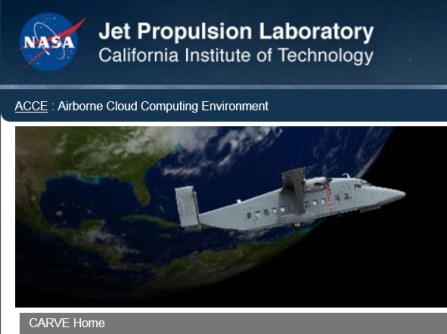
How do you know whether forest fires or factories and diesel generators are responsible for Black Carbon or CO2 in the air or deposited in icefields?  An experiment called CARVE (Carbon in Arctic Reservoirs Vulnerability Experiment) led by Chip Miller of the NASA Jet Propulsion Laboratory was conducted in Alaska’s airspace and some results just published explain how the source can be identified.  The combustion of woody biomass (or more importantly in Alaska–layers of compacted dead moss and organic soil) liberates primarily carbon deposited since World War II into CO2.  That modern post-bomb carbon contains traces of radioactive  carbon (Δ14C) in contrast to fossil fuels, deposited in prehistoric times, which have none.

carve

CARVE:  Sherpa aircraft flew sensors over fires in Alaska in 2013 to measure atmospheric concentrations of gases.


During the CARVE experiment, Sherpa aircraft flew sensors to measure atmospheric concentrations of CH4, CO2, and CO and parameters that control gas emissions (i.e. soil moisture, freeze/thaw state, surface temperature). They directly flew over some fires (including fires near Fairbanks and Delta) to measure the “fingerprint” concentrations of isotopes released by typical boreal burning.  Mouteva et al. (2015) published findings that showed most of the C in the summer skies over Alaska in 2013 was indeed attributable to forest fires and the age of the biomass converted to black carbon averaged about 20 years (range 11-47 yrs).  The authors also explore using the carbon isotope “fingerprint” of fires to estimate the average depth of consumption–since Δ14C increases with depth from the surface moss to the mesic horizon.  Pooled results of radioactive isotope fractions yielded an average depth of burn of about 8 inches for the 2013 Alaska fires–a result that may vary depending on fuel conditions.  Burn severity, expressed as depth of consumption, is a hot topic among agencies and land managers because it drives ecological response to burning as well as vegetation changes which may come with the hypothesized climate-driven increased boreal burning.

Citation:  Mouteva, G. O., et al. (2015), Black carbon aerosol dynamics and isotopic composition in Alaska linked with boreal fire emissions and depth of burn in organic soils, Global Biogeochem. Cycles: 29, doi:10.1002/2015GB005247.