Upcoming webinar: Effect of Tundra Fires on Post-fire Vegetation

Teresa Hollingsworth, USFS and Amy Breen, UAF-SNAPTundra_Fire


Apr 28, 2014  2:00 pm – 3:00 pm  AK time. Register.

https://akfireconsortium.uaf.edu >> Events

Amy and Teresa will summarize the history of tundra fires in Alaska and share preliminary results of their research to characterize post-fire plant communities, quantify fuel accumulation, and model tundra fire regimes and vegetation dynamics.

Find the recorded webinar <HERE>.


Webinar about Black Carbon in the Atmosphere

Tundra_Fire

National experts will be giving a talk to bring you up to speed on this issue if you’d like to know more about sources of soot in the atmosphere (including wildfire) and whether pollution control efforts are having any effect.  Speakers include: In-situ ground sensing: Patricia Quinn (NOAA);  Satellite remote sensing: Ralph Kahn (NASA); and Transport modeling: Mark Jacobson (Stanford).

Date: April 18, 2014  Time: 3:00-4:30 EDT (that’s 11:00-12:30 Alaska Daylight time)   Register at IARPC Collaboration website.

Find the recorded webinar <HERE>

The Atmosphere Collaboration Team of the Interagency Arctic Research Policy Committee (IARPC) is hosting the second of two webinars on black carbon which are open to the community. The intent of the second webinar is to share information about current science questions and activities related to Arctic black carbon. Experts will be on hand to share information and answer questions in an effort to inform the Atmosphere Collaboration Team of IARPC of possible future interagency activities related to Arctic black carbon.

Webinar Synopsis

Black carbon is “the second most important human emission in terms of its climate-forcing in the present-day atmosphere; only carbon dioxide is estimated to have a greater forcing.” When BC is deposited on snow and ice, it darkens an otherwise bright surface. The darker surface may enhance the absorption of solar radiation resulting in an acceleration of snow and ice melting. In addition, BC particles suspended in the atmosphere absorb solar radiation and heat the surrounding air. Atmospheric BC can also alter cloud properties leading to changes in cloud amount and precipitation. Black carbon has multiple sources including domestic combustion for heating and cooking, diesel combustion related to transportation, fossil fuel and biofuel combustion for power generation, agricultural burning, and wildfires. Identification of the sources and types of black carbon (both the geographical region of the source and the combustion process) is necessary for effectively mitigating its climate impacts. In addition, measurements of black carbon are required to verify whether implemented mitigation strategies that target BC emissions from certain sources are actually leading to reductions in BC concentrations in the Arctic atmosphere and surface. In 2013, NOAA’s Arctic Report Card added a black carbon assessment to the Atmosphere Section; the primary conclusions of the assessment are that (1) the average equivalent black carbon concentrations in 2012 at locations Alert (Nunavut, Canada), Barrow (Alaska, USA) and Ny-Alesund (Svalbard, Norway) were similar to average EBC concentrations during the last decade and (2) equivalent black carbon has declined by as much as 55% during the 23 year record at Alert and Barrow (Sharma et al. 2013).


April 8th Science for Lunch: Shortened Fire Return Intervals in Alaska


Jennifer Barnes, NPS Regional Fire Ecologist

Tuesday April 8th, 12:00 pm AK time. Contact NPS Stacia Backensto for information:  907-455-0669.

The Uluksian fire of 2007 (by P. Higuera).

The Uluksian fire of 2007 (by P. Higuera).

Jennifer will discuss the results of recent NPS studies on climate change impacts to boreal forest and tundra fire regimes.

Find the recording <HERE>.

Webinar Recording Available– 2013 Alaska Fire Modeling Lessons Learned


Lisa Saperstein, USFWS, Brian Sorbel, NPS, and Robert Ziel, DOFFireModelingLessons

Wed, March 5, 10:00 am. Visit our Vimeo page to view all our recorded webinars or find the recording <HERE>.

Organized by the Alaska Fire Modeling and Analysis Committee, this webinar employed an expert panel to look back at some of the modeling work that occurred in 2013, specifically focused on lessons learned that can be carried forward into 2014.  Some important points covered–what’s the difference between fire modeling in FSPro vs. Canadian BEHAVE system; how to tweak landscape cover and crown fire models to get reasonable results; using auxiliary information like Google Earth, Landsat imagery, and MODIS hotspots to inform your run.  Don’t forget, there is a manual–available on the FMAC page above!: FSPro Analysis in Alaska: A Users Guide

(Image: 7 day fire spread probability of Lime Hills fire, June 24, 2013, and June 30 perimeter (black line). Courtesy Lisa Saperstein.)

Webinar Summary: What do Forest Fires, Caribou, and Monster Truck Tires have in Common? by Matt Nolan

Dr. Matt  Nolan shared results from his recent airborne photogrammetry campaigns in Alaska, and related them to possible fire and forest management applications in a webinar on February 25, 2014.  There is now a 2-page Webinar Summary about the topic and you can also watch the recorded webinar on AFSC’s website <HERE>.  Dr. Nolan is a Research Associate Professor at UAF’s Institute of Northern Engineering with degrees in geophysics and arctic and mechanical engineering. He’sNolan-Webinar-2014-THUMB_Page_1 been pioneering new high-tech uses of an old tool—the aerial photo.  With new advances in computer processing and display technologies, airborne Digital SLR Photogrammetry is an even more powerful tool for field sciences, especially in remote areas like Alaska. Compared to LiDAR (Light Detection and Ranging, or aerial 3D laser scanning), the low cost of DSLR photogrammetry makes it more affordable to make time-series of high-resolution maps, opening up  new possibilities for analyzing and understanding changes in the environment. Forest inventory, fire fuels assessments (like canopy height), snow depth, and post-burn vegetation recovery and monitoring are just a few examples of applications that could benefit from time-series of topographic measurements on an annual, monthly, or other repeating basis.

Dowload Webinar Summary <<LINK>>

Outcomes Assessment: Have we learned anything from JFSP-sponsored fire research in Alaska?

Outcome Assessment: Four Alaska JFSP Projects

The Joint Fire Science Program is doing a nation-wide survey this spring (2014) to ask managers whether sponsored research in their respective regions has improved management decisions or is useful to fire management practices.  We started thinking about this for Alaska and prepared a 2-page review of a sample of four projects dating back to 2002 to see whether they have had any impact on management in Alaska, and what their outcomes appear to be today.  Principal investigators included Scott Rupp (UAF), Phil Higuera (University of Idaho), Dan Mann (UAF), and Teresa Hollingsworth (USFS-Fairbanks).  Read our review and see if you think these projects were indeed worthwhile!

Upcoming webinar: 2013 Alaska Fire Modeling Lessons Learned and Review


Lisa Saperstein, USFWS, Brian Sorbel, NPS, and Robert Ziel, DOF

Wed, March 5, 10:00 am AK time. Register.

Find the recording <HERE>

Organized by the Alaska Fire Modeling and Analysis Committee, this webinar will take a look back at some of the modeling work that occurred in 2013, specifically focused on lessons learned that can be carried forward into 2014. We expect plenty of opportunity for questions and discussion. Target audience would be Alaska fire modelers or anyone with an interest in fire modeling in Alaska.

Image: 7 day fire spread probability of Lime Hills fire, June 24, 2013, and June 30 perimeter (black line). Courtesy Lisa Saperstein.

Upcoming webinar: What do Forest Fires, Caribou, and Monster Truck Tires have in Common?

Tues, Feb 25, 10:00 am AK time. Register.

Link to recording <HERE>

Please join us for a very exciting chance to hear Matt Nolan of the UAF Water & Environmental Research Center, who will share results from his recent airborne DSLR photogrammetry campaigns throughout the Alaskan Arctic and the Fairbanks area.  Advances in camera, GPS, and processing technologies over just the past few years have enabled Matt to put together a relatively inexpensive photogrammetry system that is easy, fast, accurate, and precise with no ground control. Compared to lidar, the low cost of DSLR photogrammetry means that it is now affordable to make time-series of high-resolution maps, and such time-series open up many new possibilities for analyzing and understanding changes in the environment, including topography, vegetation, and disturbance.
How could these new capabilities help fire managers and researchers?

See examples of Matt’s campaigns at http://www.drmattnolan.org/photography/2013/#

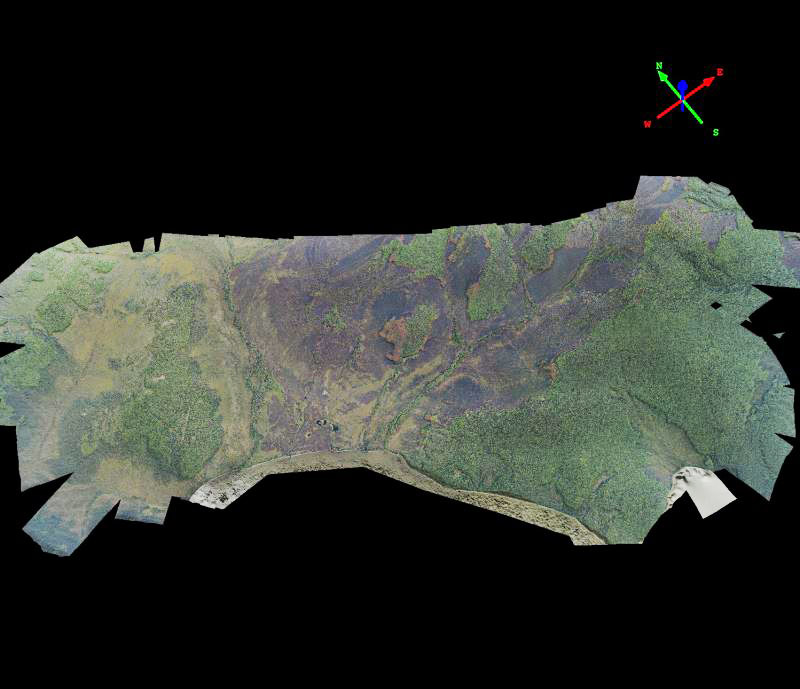
Image: Orthomosaic of Beaver Log Lakes fire scar near Lake Minchumina, 2013, courtesy Matt Nolan.
Image

Research Brief: Fire Severity Filters Regeneration Traits to Shape Community Assembly in Alaska’s Boreal Forest

Fire Severity Filters Regeneration Traits RB-2014-1thumbto Shape Community Assembly in Alaska’s Boreal Forest:  A recent paper by Hollingsworth et al. (2013) proposes that fire severity and a plant’s intrinsic regeneration strategy are key determinants in post-fire community recovery.  The authors identify species that may fare better or worse with predicted changes in Alaska’s fire regime. Hollingsworth–who is based at the University of Alaska-Fairbanks–bases her findings on a large (n = 87) and geographically diverse set of post-fire plots in interior Alaska boreal forest.

Read More >>  |  Download Research Brief PDF (850 kb)

Participate in JFSP Fuel Treatment Science Plan Survey

Your input is requested on fuel treatment research.

The Joint Fire Science Program (JFSP) has undertaken a broad scope project to determine important research needs related to fuel treatment and develop a Fuel Treatment Science Plan. This plan will affect the policy, research, and management aspects of the fuel treatment program. It will have implications across local, regional, national, and interagency planning scales; across the range of short-intermediate, and long-term temporal scales; and will assist project and/or plan development across site-specific, project, unit, landscape, regional, and national level spatial scales. Specifically, this plan will outline future relevant fuel treatment research topics for JFSP consideration.
 
In order to fully address this topic, it is necessary to identify sources and conduct thorough information gathering. As part of this effort, contact with program leaders, stakeholders, project managers, and practitioners is critically important. This questionnaire has been developed to help obtain feedback and input. It consists of questions in the areas of fuel treatment importance, barriers and impediments to implementation, tools and guidance information, and areas of future research focus.
 
You are receiving this questionnaire because your input is valued and needed. Due to governmental rules and procedures, the initial questionnaire could only be distributed to federal employees and entities. This questionnaire is being distributed through the Northern Rockies Fire Science Network and The University of Montana to permit the widest distribution across all non-federal agencies, organizations, and individuals interested in fuel treatment. Please feel free to distribute this invitation and link to other individuals that have a role, interest, and involvement with fuel treatment activities.
   
The following link provides access to the non-federal questionnaire. We would ask you to complete the questionnaire before January 31, 2014 to facilitate analysis of the results.  https://www.surveymonkey.com/s/QYVSMNL
 
In the event any federal employees receive this message and are interested in completing the questionnaire, please use the following link to access the federal version and do not use the above listed link: https://www.surveymonkey.com/s/98H9BHM  
 
Please don’t hesitate to email us with questions or comments [put “Fuel Treatment Science Plan” in the subject line].  We thank you for your interest and support for this project.
 
Vita Wright
Northern Rockies Fire Science Network
vita.wright@umontana.edu
 
Tom Zimmerman
tomzimmerma@gmail.com